

Come out and Play!
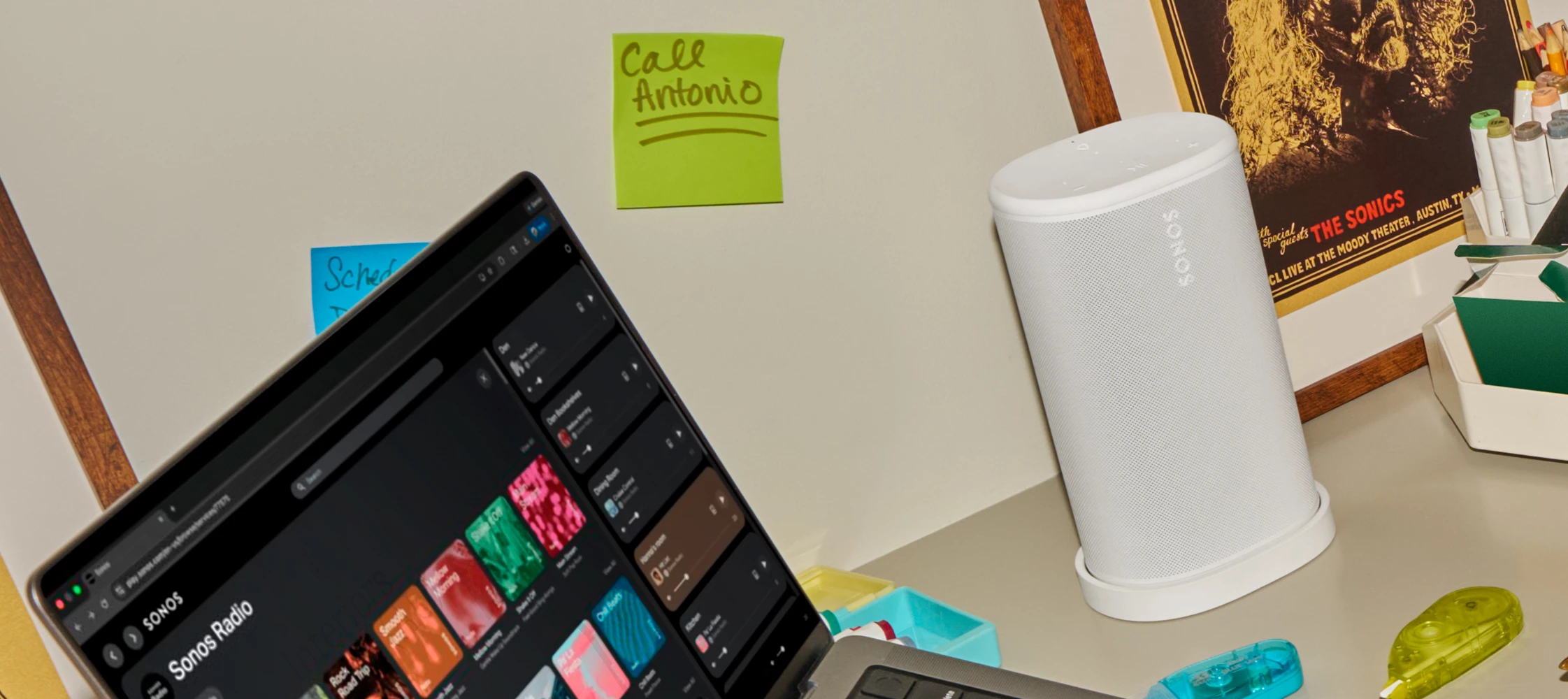
The day is finally here! A few weeks ago, we introduced you to our newest portable speaker, and today, I am excited to announce that Sonos Play is officially available for purchase at sonos.com and in a store near you.
Play was designed to be the most versatile building block in your Sonos system—a true home speaker that just so happens to be able to join you on your travels. Let’s get into the product specs, technical details, and all the cool new stuff Sonos Play can do.
Basics
Sonos Play features:
- stereo sound
- 24 hours of battery life
- IP67 water rating
- drop resistant
- WiFi 6, Bluetooth 5.3
- charging base included
- convenient and removable utility loop
- grouping on the go
The hardware playback controls can be used by pressing the play/pause button once (to play or pause), twice (to skip to the next track), or three times (to skip to the previous track).
There are also dedicated volume buttons, a Voice Control button (for Sonos Voice Control and Alexa), a microphone on/off switch (this also impacts Automatic Trueplay), a Bluetooth pairing button, and a power/sleep button. It has a microphone LED at the top, a status LED facing front, and a power LED at the bottom, along with three microphones and an ambient light sensor on top.
Audio
Let me jump straight to your most frequently asked question - how does Play compare to Move 2 and Roam 2? Play is essentially the offspring of the two, just about a 50/50 split down the middle - closer in size to the Roam 2, but closer in audio profile to the Move 2. It really is the “just right” Goldilocks speaker. One thing they all share in common: Automatic Trueplay tunes each speaker to the unique acoustics of the environment you use them in.
Where Roam has maximum portability and the smallest design, there's only room for one tweeter and one woofer, which limits the ability to accurately reproduce stereo audio. In my book, Roam takes a slight lead for portability, but Play knocks Roam 2 out of the park on sound quality.
Move 2 is bigger and bulkier, which gives it extra low-end compared to Play, but that also makes it less convenient to throw in a backpack or bring in a carry-on bag. Once you get above a certain threshold, Move 2 takes the lead in terms of maximum volume and overall bass response. But especially at lower volumes, you might not be able to easily distinguish between them.
Play features three class-H digital amplifiers that power one midwoofer and two tweeters, which allows for stereo separation like Move 2. But unlike Move 2, it also incorporates two passive radiators to deliver deeper bass.
And of course, you can easily pair two Play speakers together over Wi-Fi for an even wider soundstage. Just a quick tip: to get the most spatial separation, don't keep your stereo pair of Play speakers too close together. You've gotta keep 'em separated.
Battery and Charging
Let me be up front: Sonos Play comes with a really cool charging base, but it doesn't include a power adapter. I know this may lead to some frustration, and we've had quite a lot of discussions about this internally.
What it boiled down to is that we have made a genuine commitment to reducing our environmental impact. We've found that USB-C chargers have become quite ubiquitous with our customers, and we know that a potentially significant portion of chargers in the box would become e-waste.
For those that are interested in sustainability, I'd encourage Sonos customers to check out our commitments to sustainability to learn more. For instance, check out our work on developing the world's first Sound Sanctuaries! 💙
To charge Sonos Play, we recommend a USB-PD certified 15V / 3A (45W) power adapter. With a 45W or higher USB-PD adapter, Play charges from 0-50% in about 1 hour, and 50-100% in about 2 hours (3 hours total from 0-100%). The minimum supported adapter is 9V / 2A (18W). If the adapter is less than that, the charging base will blink red and the speaker will fail to charge.
Note: for more info on Sonos charging requirements, check out this article by u/LizFromSonos!
A few neat power tips:
- Power Drain: When resting fully charged on its base, idle power consumption is only about 1.6W. When off the charging base and fully powered off (not sleep mode), it should lose 1% or less per day. In my own testing, it lost less than 0.5% per day in a temperate environment
- Power Bank: If your phone battery gets low while off the grid, Play can charge your devices via the USB-C port at up to 5V / 1.5A (7.5W).
Portability
Sonos Play features a convenient utility loop/carrying strap, which is both removable and replaceable, and it really adds to the flexibility of this product. I've found myself hanging it all over the place: on a hook outside the shower, from the corner of a chair in the backyard, around the handle of a cabinet in the kitchen. It really elevates the sound (pun intended) and makes it much more adaptable to the environment.
The strap isn't indestructible, though; it's been tested to hold up to 4 times the weight of the speaker itself, which weighs 4.48 lbs/2.03kg. Be careful not to stretch, pull, or swing the loop too hard (as I did for testing purposes) and you'll find it's built to last.
With the IP67 rating, you can submerge Play in up to 1 meter of water for up to 30 minutes. To put it another way - you don't have to worry about accidentally dropping Play into the bath or getting it wet in the shower. Keep in mind that other chemicals (like pool water sanitizers and salty ocean water) can cause unexpected damage and should be avoided.
Networking & Connectivity
As part of my testing for grouping outside of WiFi (more on that below), I found myself also testing the boundaries of what Bluetooth 5.3 could do. For those of us that remember the early days of Bluetooth, it's fair to say that the range of Bluetooth these days is pretty mind boggling.
For example, I tried putting my Play on one side of the house, then went upstairs and across to the other side of the house and started playing music on my phone. When I went back to the speaker, it was playing without a hitch - so I took it outside. It wasn't until I started getting to my neighbor's neighbor's house (two doors down) that I finally heard interruptions. Mind blown! 🤯 Of course, this entirely depends on the environment, and your mileage may vary. Try it out and let me know in the comments how it goes.
The line-in functionality is also pretty handy. I tested with an iPod, a record player, and a phone, all of which came through loud and clear. Note that you may need to adjust the line-in settings (particularly the Line-In Level) to get the best audio without clipping.
New Features
One of my favorite new features is the ability to group up to four Sonos Play and/or Move 2 speakers while you're away from WiFi. I've written a separate deep-dive about grouping on the go, so jump on over for all the glorious details on that topic. But suffice it to say - I look forward to using that to push the boundaries in new and exciting ways. Sonos on a boat!
The other feature that I think of as the "Ace in the hole" is that Sonos Play can be used as a power bank for your phone or other USB-C devices. This is one of those features that I don't imagine most people would use frequently, but when you do need it (say, while out in the middle of the woods and your phone dies), it will come in clutch. It can provide 5V up to 7.5W, meeting the USB BC 1.2 standard.
Wrap-Up
Sonos Play is available globally starting today in Matte Black and Matte White for $299 USD / $399 CAD / €349 EUR / £299 GBP / $499 AUD.
I know that’s a ton of info, so if you have any thoughts, questions, or feedback, let me know! I know some of you have already gotten your hands on Play, and I can’t wait to hear what you think. I'll be hanging out in the comments to join in on the discussion.