

Liz P.
Sonos Staff
March 25, 2026
F.A.Q.

Before You Blame the Speaker: Check Your Charger First
  • March 25, 2026
  • 36 replies
  • 1183 views

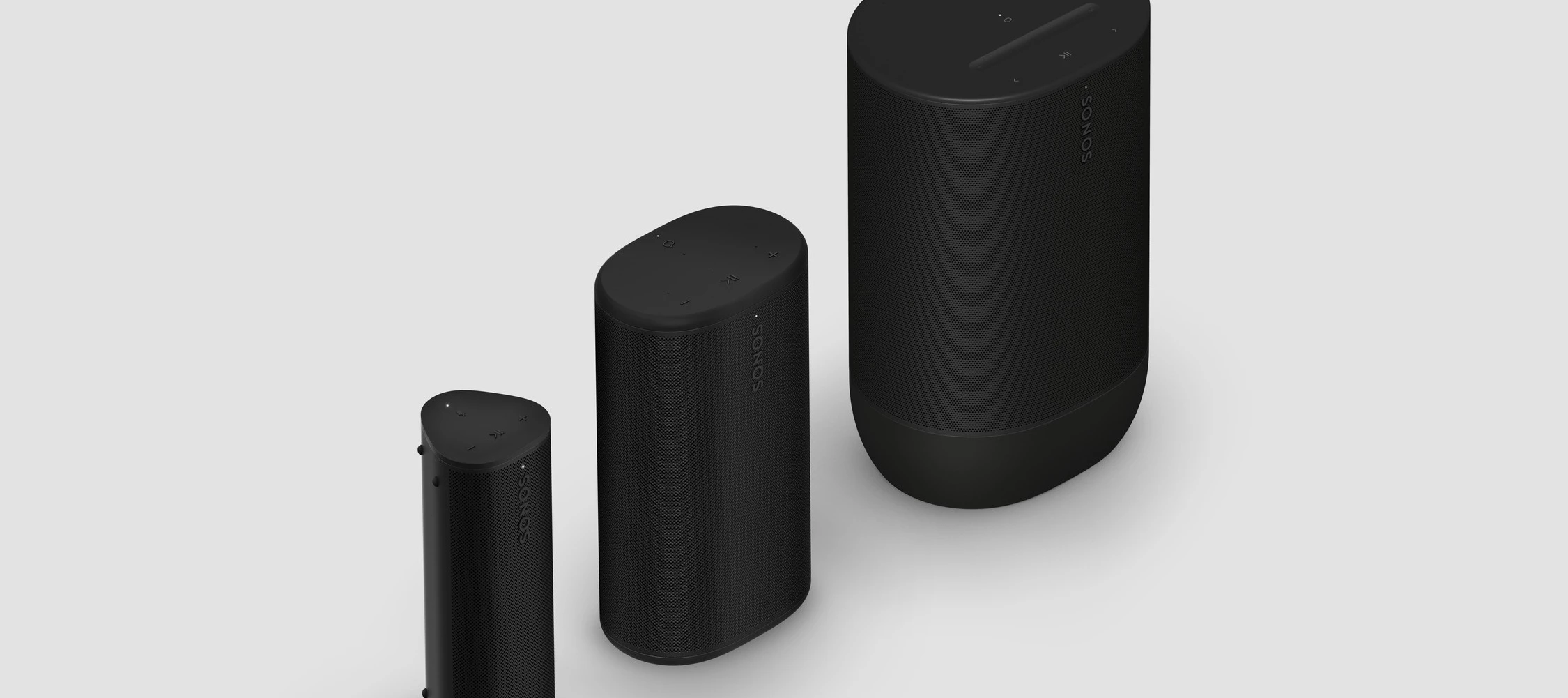
Hey all! With Sonos Play being added as the newcomer to the lineup next week I thought it would be a good time to cover some charging and power requirements, as we have quite a few devices that have these now.

Your speaker needs a power adapter and cable that is powerful enough to charge it effectively. If your device is charging slowly, it's typically because the cable or adapter is too low-power.


For smooth charging, make sure your adapter and cable meeting the following:

Product

Minimum Power/Current

Recommended Power/Current

Roam/Roam 2

5V/1.5A (7.5W)

5V/2A (10W)

Ace

5V/0.5A (2.5W)

5V/3A (15W)

Move

12V/3A OR 15V/2.4A (36W)

20V/2.25A OR 15V/3A (45W)

Move 2

20V/2.25A OR 15V/3A (45W)

20V/2.25A OR 15V/3A (45W)

Play

9V/2A (18W)

20V/2.25A OR 15V/3A (45W)


Quick Tips:

  • Check your adapter: You can usually find the voltage/amperage (V/A) or wattage (W) printed on the back of the power adapter itself or on the website where you purchased it.
  • Cables Matter: If you’re using the Sonos USB-C Power Delivery (PD) cable that came with your device, you're good to go. For third-party cables, make sure they are PD-capable and meet the charging requirements. For devices that are not Roam and Roam two we recommend a USB-C cable.
  • Ditch your old phone power adapters. Tablet power adapters are probably good enough (depending on how old your tablet is) but phone power adapters usually won’t be enough. As always, check the info on it if you can! 

How do I know my device is charging?

When your device starts charging the light will turn solid orange. If the speaker is blinking orange it means the battery has a low charge. For information on what other light colors mean, check here.

What if I’m using a multiport charging adapter? 

If you’re using a multiport changing adapter the wattage provided per device will depend on how the manufacturer distributes the wattage. For example, if you have a 45W adapter and plug in your phone, tablet, and Play it will default to provide 15W to each device. For how the wattage is distributed we recommend checking with the manufacturer. 

What if I want to fast charge my device?

To fast charge most of these devices you need a PD capable power adapter as well as a USB-C cable that is capable of fast charging.

Note: Sonos Roam and Roam 2 do not support fast charging.

Can I leave my portable Sonos device permanently connected to a charger, either wireless or USB-C?

Sonos portable devices are designed to and can be left on the charger as long as they are up to date. 


What chargers do you use that work well? Share your recommendations below.


36 replies

melvimbe
March 26, 2026

​@melvimbe 

So per the footnote the likelihood of damaging devices currently made with the USB-C standard is remote. As the device only pulls what it needs.

Agreed.  I also thought this was in line with what Liz stated in her quick tips

Danny
Local Superstar
March 26, 2026

It’s been my research (if I understand your question correctly) the charger could have a 15V/3A (200W)  capacity...


Besides the fact that there are standards to prevent damage (that Sonos complies with), James Watt must be turning in his grave now at those maths. Power is voltage multiplied by current. 3 x 15 is 45W, nowhere near 200W. 😔  A 15 x 3 is a 45W capacity.  Although a quality 200W charger should have the ability to charge at 45W though. 

If you're only seeing highs of 15W being drawn from a higher powered device, something is wrong there too. 

AjTrek1
March 26, 2026

It’s been my research (if I understand your question correctly) the charger could have a 15V/3A (200W)  capacity...


Besides the fact that there are standards to prevent damage (that Sonos complies with), James Watt must be turning in his grave now at those maths. Power is voltage multiplied by current. 3 x 15 is 45W, nowhere near 200W. 😔  A 15 x 3 is a 45W capacity.  Although a quality 200W charger should have the ability to charge at 45W though. 

If you're only seeing highs of 15W being drawn from a higher powered device, something is wrong there too. 

You took that wayyy toooo literally. It was only mentioned for effect as being over the top. It has been agreed that regardless the capacity of the power adapter the device being charged only takes what it needs. 

Together Everyone Achieves More = T.E.A.M.
Local Superstar
March 26, 2026

So ‘ability’, not ‘capacity’?

A high of 15W still seems very strange though.

Stanley_4
Grand Maestro
March 26, 2026

15 Watts, no problem, how about 240 Watts?

https://www.usb.org/usb-charger-pd

Announced in 2021, the USB PD Revision 3.1 specification is a major update to enable delivering up to 240W of power over full featured USB Type-C® cable and connector. 

New 28V, 36V, and 48V fixed voltages enable up to 140W, 180W and 240W power levels, respectively.

The PD spec lays out the handshaking a device must use to request more than the minimum power delivery voltage and amperage.

Local Superstar
March 27, 2026

​@Liz P. , as this is FAQ, I would like to see an official answer to the following, as I can’t see it documented anywhere:


Can I leave my portable Sonos device permanently connected to a charger, either wireless or USB-C?

It would be useful to know if the devices charging circuitry will not affect the battery life if the device spends the vast majority of its life sitting on a charger, either being used, or silent, and occasionally removed from charger. I’m assuming the answer may be different for different devices, eg original Roam vs the new Play?

AjTrek1
March 27, 2026

​@Liz P. , as this is FAQ, I would like to see an official answer to the following, as I can’t see it documented anywhere:


Can I leave my portable Sonos device permanently connected to a charger, either wireless or USB-C?

It would be useful to know if the devices charging circuitry will not affect the battery life if the device spends the vast majority of its life sitting on a charger, either being used, or silent, and occasionally removed from charger. I’m assuming the answer may be different for different devices, eg original Roam vs the new Play?

Find the answer in the link. Scroll down to almost the end. However the short answer is “no”.
 

https://support.sonos.com/en-us/article/charging-sonos-play

Together Everyone Achieves More = T.E.A.M.
Local Superstar
March 27, 2026

Find the answer in the link. Scroll down to almost the end. However the short answer is “no”.
 

https://support.sonos.com/en-us/article/charging-sonos-play

I don’t have a Play. The link suggests its OK for a Play to be left on charge:

Leaving Play on the charging base long-term will not reduce the battery’s lifespan.

It would be useful for users of other portable Sonos products to have this question answered. I suspect the charging circuit in the original Roam is not as intelligent as the new Play device, so whilst is OK to leave a Play on charge, it may not be OK to leave a Roam on its wireless charger. Would be nice to have an official answer from Sonos.

AjTrek1
March 27, 2026

Find the answer in the link. Scroll down to almost the end. However the short answer is “no”.
 

https://support.sonos.com/en-us/article/charging-sonos-play

I don’t have a Play. The link suggests its OK for a Play to be left on charge:

Leaving Play on the charging base long-term will not reduce the battery’s lifespan.

It would be useful for users of other portable Sonos products to have this question answered. I suspect the charging circuit in the original Roam is not as intelligent as the new Play device, so whilst is OK to leave a Play on charge, it may not be OK to leave a Roam on its wireless charger. Would be nice to have an official answer from Sonos.

The link below gives information on Move and Move 2 leaving on Charger. Again the short answer is “no”. You’ll have to scroll and also tap on “More”.

Can’t find any information for Roam products regarding your question.

https://support.sonos.com/en-us/search?q=Wireless+charging+
 

Together Everyone Achieves More = T.E.A.M.
buzz
Grand Maestro
March 27, 2026

In general lithium batteries love to be kept on their charger. Older NiCd technology usually did not like to be kept on the charger, depending on the charger design. With respect to ROAM, I notice that the battery is kept warm if the unit always on the wireless charger. This will decrease battery life somewhat, but allowing regular full discharge is worse.