
Ryan S
Retired Sonos Staff
January 21, 2020

End of Software Updates for Legacy Products
Related content:Software
End of Software Updates for Legacy Products

Please note that we’ve created a new thread with some clarifications to questions that have come up several times in this thread. Please see here to continue the discussion if you still have any questions. The information contained in this thread is outdated and may no longer be accurate.


We have some important news regarding our oldest Sonos devices shared on the Sonos Blog today. The text of that blog post is being included here for your convenience:


Starting in May 2020, some of our oldest products will no longer receive software updates or new features. We want to explain why and your options. 

When we first set out almost 20 years ago to invent the technology to easily listen to any song in any room, most of the ways we listen to music today did not exist. In fact, the first Sonos products were introduced before the first iPhone was announced and when Myspace still ruled social media. 


In order to invent multi-room music and smart speakers, we combined the worlds of high-fidelity audio and computing. Every Sonos product has a microprocessor, flash memory, and other hardware components typically found in computers and smartphones.  


Since launching our first products, technology has advanced at an exponential rate; from streaming services and voice assistants to wireless networking and Bluetooth capabilities.  Through all of this transformation, we have continued delivering new features via software updates. We’re extremely proud of the fact that we build products that last a long time, and that listeners continue to enjoy them. In fact, 92% of the products we’ve ever shipped are still in use today. That is unheard of in the world of consumer electronics. However, we’ve now come to a point where some of the oldest products have been stretched to their technical limits in terms of memory and processing power.  

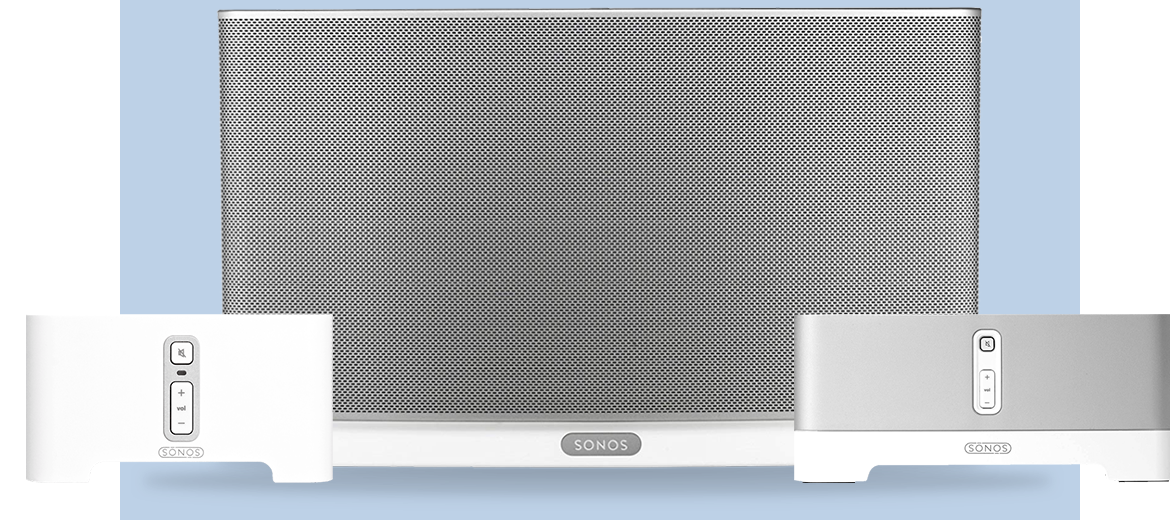
This coming May, these legacy products—our original Zone Players, Connect, and Connect:Amp (launched in 2006; includes versions sold until 2015), first-generation Play:5 (launched 2009), CR200 (launched 2009), and Bridge (launched 2007)—will no longer receive software updates or new features. 

 Today the Sonos experience relies on an interconnected ecosystem, giving you access to more than 100 streaming services, voice assistants, and control options like Apple AirPlay 2. Without new software updates, access to services and overall functionality of your sound system will eventually be disrupted, particularly as partners evolve their technology. 

To help you through this transition, we’re providing two options:

Option 1: Continue using these legacy products, recognizing that your system will no longer receive software updates and new features.  

Option 2: Trade up to a new Sonos product with a 30% credit for each legacy product you replace.

If you’re not sure if your products are affected, you can check in the System tab in your sonos.com-account

If you choose to participate in the trade up program, your legacy products will be put in Recycle Mode, a state that deletes personally identifiable information and prepares these products for e-recycling. Recycle Mode also protects unsuspecting people from buying legacy products that are approaching the end of their useful life and won’t provide the Sonos experience customers expect today. Recycle Mode will only apply to the legacy products listed above.


We ask that you take your legacy products to a nearby certified e-recycling facility. This is the most environmentally friendly way to recycle. That said, if there isn’t a facility in your area, we are happy to pay for you to ship your products back to Sonos for responsible recycling.    


Ideally all our products would last forever, but for now we’re limited by the existing technology. Our responsibility here is threefold: build products that last a long time; continually look for ways to make our products more environmentally friendly through materials, packaging, and our supply chain and take responsibility for helping you through the transition once products near the end of their useful life.  


We’ve always believed in freedom of choice, whether that means choosing a certain streaming service or way to control your listening experience. We hope the choices provided here—continuing to use these products without new software updates or trading up to our modern products—enable you to make the choice that’s right for you. 


We are honored to have a place in your home and want to make sure that we help continue to bring the best experience we can, even when products reach the end of their useful life. 


More information.


Please let us know if you have any questions.

    This topic has been closed for further comments. You can use the search bar to find a similar topic, or create a new one by clicking Create Topic at the top of the page.

    1377 replies

    Lyricist II
    January 21, 2020

    Folks, given the price of these units, this course of action is simply unacceptable. I can’t believe that there isn’t a way to maintain legacy products within a updated system to allow for basic functionality.

    If the recycle promotion offered a greater discount on replacement items (say 75% off) that would be one think, but 30% off replacement equipment for an arbitrarily imposed EOL (or the alternative - a SONOS system stuck with no further updates) is insufficient.

    I have recommended SONOS products to many of my friends and family because of the great experience I’ve had to date. Now I doubt I’ll ever buy the equipment again, not with an arbitrary off switch built into all of them.

    I hope you’ll reconsider either your approach for legacy products, or the discount you offer on replacement equipment.

    Translate
    Legnum Nick
    Prodigy III
    January 21, 2020

    I’m another person with more than half of their Sonos stuff becoming obsolete and a four figure bill to get back to what I currently have.  I scrimp and save to buy my hifi, significant investments don’t happen that often. One of my Connects is wired to a twenty year old AV amp and the other a 30 year old Cambridge pre amp!  Speakers in one room are 16 year old floor standing KEFs.  My Sonos stuff is about the youngest bits of equipment I have.

    Two other households I know have bought Sonos products because of my recommendations.  The way I feel right now, that is very unlikely to happen again.  30% off replacement items means some of my stuff is depreciating faster than a high mileage car!  I genuinely love my Sonos, more each day, and to have half of it tainted like this has made me feel sick. 

    There are two ways I can see to help people out here - one would be a MUCH bigger discount on replacement products and the other would be a promise to keep updating “Legacy” items as much as possible to stay abreast of music services.  Freezing them seems like a promise that incompatibility with the future is not only guaranteed but embraced.

    I truly hope that when the negative impact of this decision becomes apparent through this thread and other means, another email that sounds a bit more positive is received.

    Translate
    Enthusiast II
    January 21, 2020

    So just checked with a lawyer friend of mine - his view, In Europe, if you bought any Sonos product in the last 6 years that is affected by this you can take it back to the original retailer and get your money back! 


    Yeah, I was thinking about the 6 year rule. 


    I would guess that depends if any features are lost though?


    Announcing this now and saying info will be available in 5 months is a bit off. 

    Translate
    Lyricist I
    January 21, 2020

    So, my Klipsch speakers purchased in 1990 are still going strong, but my Play 5 and bridge are to be rendered obsolete after eight years.  That doesn’t sit well with me at all as these are by no means inexpensive, throw away items.  I will not be spending any further money on Sonos products while I have indeed purchased more sets of Klipsch speakers over the years.

    It also makes me wonder how long before my other Sonos devices are rendered obsolete??

    Translate
    Trending Lyricist I
    January 21, 2020

    Sonos has been considering this for well over a year, as this quote comes from Sonos’ November 2018 10-K filing:

    We may choose to discontinue support for older versions of our products, resulting in customer dissatisfaction that could negatively affect our business and operating results. We have historically maintained, and we believe our customers have grown to expect, extensive backward compatibility for our older products and the software that supports them, allowing older products to continue to benefit from new software updates. We expect that in the near to intermediate term, this backward compatibility will no longer be practical or cost-effective, and we may decrease or discontinue service for our older products. Therefore, if we no longer provide extensive backward capability for our products, we may damage our relationship with our customers, and the value proposition of our products with  existing  and  prospective  customers  may  decline.  We  may  lose  existing  customers  if  their  older  products  cannot  integrate  with  newer  versions  of  our software,  and  this  may  also  result  in  negative  publicity  that  could  adversely  affect  our  reputation  and  brand  loyalty  and  impact  our  ability  to  attract  new customers or sell new products to existing customers. For these reasons, any decision to decrease or discontinue backward capability may decrease sales and adversely affect our business, operating results and financial condition.

    haha so some financial analyst folks at Sonos had actually, honestly looked at how detrimental this move could be to the company and somehow someone convinced the bigwigs to do it anyway?


    you could not make this shit up! I imagine Sonos offices are like an episode of the office. 


    Not Mr. McRae from the M3 forums? 


    hell yes dood :) 

    Translate
    Lyricist I
    January 21, 2020

    I recently read an article in which the writer predicted that Apple would soon acquire Sonos in an attempt to get their foothold back in the home-audio market. I knew I recognized this kcid move from somewhere. Looks like it’s all coming together. Apple can gnikcuf have ‘em.

    Translate
    Contributor I
    January 21, 2020

    What a disappointment in a company that I have been a supporter and free advertiser to friends and family for years. Sonos was indeed an industry disruptor at some point and provided top notch products and customer service. What happened to you guys? 

    I have 6 “legacy” products that won’t receive updates after May 2020 - which is basically over half of my system and in fact, are my main components - so more like 90% of my Sonos setup just lost its value and potentially functionality in the future. As many here, I have spent thousands on Sonos products and had no idea that speakers would become obsolete. In fact, I just added a new Beam to my TV… I wonder how long till that is obsolete as well? I understand that hardware can’t be designed to support features 10 years from now. However, I fully expect it to support all EXISTING services as it does today, even if services change. I don’t need any additional bells and whistles but I do need it to do what it does today for as long as I own them as long as I don’t break them. Is that an unreasonable expectation? 

    You stated in your original post that “In order to invent multi-room music and smart speakers, we combined the worlds of high-fidelity audio and computing. Every Sonos product has a microprocessor, flash memory, and other hardware components typically found in computers and smartphones.”  There lies a reasonable approach actually: high-fidelity audio components do not get outdated, they will sound just as good in 10 years as they do today. So, the reasonable upgrade path would be to offer replacement of the memory/microprocessor/outdated speaker components to support the new features for people who want them. People send them in, you upgrade the components, and ship them back - all for a reasonable price (hopefully). People who do not want the new features and don’t want to upgrade should still be supported with the same services as they do today.

    Most modern electronics have memory and microprocessor in it. If I buy a high-end receiver today, I understand that I should not expect it to support all future technologies that will come; but I do expect it to support ALL features that it supports when I bought it. So as long as you will continue to make sure the same functionality is supported on the “legacy” components - I think it is fair. But if you completely drop support for them and leave your customers hanging - that would be an extremely poor behavior.

    Lastly, offering a 30% discount if your customers want to upgrade to new features in new products is generous and I appreciate it. However, offering a 30% discount because you are basically killing support for all the components we already spent (a lot) of money on in the neat future and can’t guarantee that they will work with the same features they do today is a huge slap in the face and not a generous offer at all. Why would anyone spend hundreds on the upgraded “modern” components if some years down the line the same components will also become not supported? I really do hope Sonos will put their thinking hat back on and reconsider this approach. I have never regretted my decision of going with Sonos system, and for the first time - I am.


    Translate
    Lyricist I
    January 21, 2020

    I have a Play5 becoming obsolete.


    Sonos, please respond. When will my play1s (4 of them), play3, soundbar, and sub be obsolete? 


    Please clarify what level of hardware each product has. Maybe you can’t tell me when you will stop supporting equipment, but tell me what’s next. 
     

    unhappy customer 

    Translate