
Peter Mc
April 11, 2019

Amp freq response: Sonos vs Peachtree

  • April 11, 2019
  • 84 replies
  • 6698 views
There have been questions about the high frequency response of the Sonos Amp. User hodgeal posted a very interesting plot showing the frequency response of the Sonos Amp using the software REW. It didn't show excessive high frequencies in that single test.

I had the opportunity to compare the Sonos amp to my Peachtree amp using the same software (which is very useful and easy to use - thanks hodgeal), and this provides a comparative test of the Sonos Amp frequency response.

The Peachtree Nova 125 SE amp is well-respected in the audio community. It is a class D digital amp, same as the Sonos Amp, but as far as I can tell uses different chips. The test uses Duntech Marquis speakers and a Studio Projects C1 microphone. The mic is setup on-axis at a distance of 120cm, which is pretty standard. But none of the details should matter because this is a comparison under identical conditions - I simply swapped amps and repeated the test.

And the results?
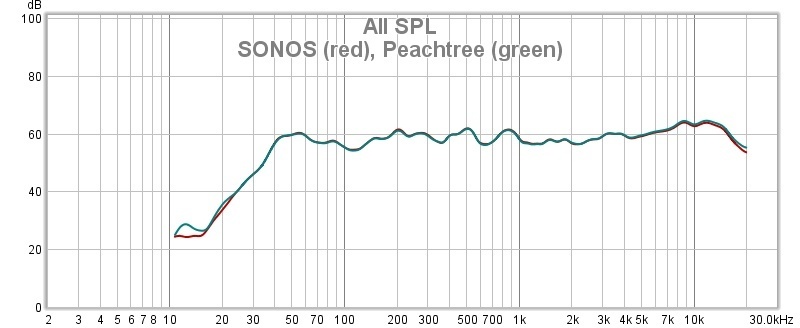


As you can see, the amps are almost identical. Ignore low frequencies - they vary from test to test even with the same amp below about 30Hz. At high frequencies, above about 4kHz, the Peachtree gets gradually brighter, ending up being about 1.5dB louder at 20kHz. This would be imperceptible to pretty much everyone.

Note that there is a slight increase in high frequencies above about 7kHz for both amps, so this could be the speakers. However, I think this is due to the frequency response of the microphone - the specifications show a similar slight increase.

Cheers, Peter.
    This topic has been closed for further comments. You can use the search bar to find a similar topic, or create a new one by clicking Create Topic at the top of the page.

    84 replies

    pwt
    Virtuoso
    April 21, 2019
    Of course, this will mean the lowest possible volume is also increased.
    Presumably, since the Amp's gain is entirely under software control, Sonos can calibrate it however they wish for different volume settings.
    4 x P:5 | Sub | 4 x P:1 | 3 x Connect | 2 x Boost | Connect:Amp | 2 x One | Amp | Move | Port | Era 300
    Peter Mc
    Peter McAuthor
    April 21, 2019
    Presumably, since the Amp's gain is entirely under software control, Sonos can calibrate it however they wish for different volume settings.
    Agreed. They could have no boost at low volumes and larger boost at high volumes. Although, it is a bit of a coincidence that both hodgeal (in the original LS50 thread) and I found an exact 3 dB boost at whatever volume we tested (I was at 30%, I don't know about hodgeal).

    Cheers, Peter.
    "The presence of those seeking the truth is infinitely to be preferred to those who think they've found it" - Terry Pratchett
    Peter Mc
    Peter McAuthor
    April 21, 2019
    A small snippet of information gleaned in reading about power:
    3 dB is a doubling of power, but it takes 10 dB to achieve a perceived doubling of loudness.
    So 3 dB changes are noticeable but not big.
    "The presence of those seeking the truth is infinitely to be preferred to those who think they've found it" - Terry Pratchett
    April 22, 2019
    I had not thought of it that way; but if it is a doubling of the power then that is a lot gained by just adding a Sub. As much as is gained by the Sonos Amp over the Connect Amp.
    The Sonos Amp becomes 250 wpc into 8 ohms?!
    Peter Mc
    Peter McAuthor
    April 22, 2019
    I think it is more accurate to say that it is 125W into 8 ohms for a reduced range of frequencies compared to the normal 20-20k measurement. Frequencies below 80Hz (or whatever the crossover is set at) are excluded from the power rating. The power supply doesn't magically get any beefier. A good fraction of an amp's power is used driving low frequencies.

    Cheers, Peter.

    p.s. The Amp plus powered sub combo might now be 250W.
    "The presence of those seeking the truth is infinitely to be preferred to those who think they've found it" - Terry Pratchett
    April 22, 2019
    I think it is more accurate to say that it is 125W into 8 ohms for a reduced range of frequencies compared to the normal 20-20k measurement.
    p.s. The Amp plus powered sub combo might now be 250W.

    Why is it wrong to say it is 250W into 8 ohms for a 80-20k measurement? Isn't that what the p.s. also conveys, if the Sub delivers 250 wpc from 20 to 80 hz, that the combination is 250 wpc from 20-20k?
    April 22, 2019
    There is a better set of questions to ask:
    Suppose the same Sub was to be attached to the Sub out of a traditional HiFi stereo amp of the same power spec of the Sonos amp, 125 wpc into 8 ohms across 20-20k.
    1. Would that combo now be 250 wpc also?
    2. The 3dB boost seen here, isn't typical for such amps, as far as I know. So how does this ability to drive the 80-20k to higher sound levels than before achieved? And if it never gets achieved, with unused headroom even with amp volume at 100%, does it mean that the combo is NOT 250 wpc, but 125 wpc as it was minus the Sub?
    April 22, 2019
    Also, a question of the Sonos Amp for confirmation: If music content minus frequencies below 80hz is played, will it sound noticeably louder every time the Sub is toggled on in the app with no other change in how the music sounds?
    Peter Mc
    Peter McAuthor
    April 23, 2019
    Why is it wrong to say it is 250W into 8 ohms for a 80-20k measurement?
    Given an 8 ohm impedance, I think the Amp can only put out 125W - this would be determined by the design of the amp, in particular its ability to push current through an 8 ohm load. If that power (ability to push current) is spread over 20-20k, you get a certain sound level. If that power is limited to 80-20k, then frequencies above 80 Hz can have a 3dB increased sound level (i.e. more current), but the total power is still 125W. The power saved from not having to reproduce the low frequencies is now able to be utilised for frequencies above 80 Hz. But the total available power is fixed at 125W by design.

    Cheers, Peter.
    "The presence of those seeking the truth is infinitely to be preferred to those who think they've found it" - Terry Pratchett
    Peter Mc
    Peter McAuthor
    April 23, 2019
    Also, a question of the Sonos Amp for confirmation: If music content minus frequencies below 80hz is played, will it sound noticeably louder every time the Sub is toggled on in the app with no other change in how the music sounds?
    I think this is correct. It is demonstrated by the measurements hodgeal and I made.
    "The presence of those seeking the truth is infinitely to be preferred to those who think they've found it" - Terry Pratchett