
Peter Mc
April 11, 2019

Amp freq response: Sonos vs Peachtree

  • April 11, 2019
  • 84 replies
  • 6698 views
There have been questions about the high frequency response of the Sonos Amp. User hodgeal posted a very interesting plot showing the frequency response of the Sonos Amp using the software REW. It didn't show excessive high frequencies in that single test.

I had the opportunity to compare the Sonos amp to my Peachtree amp using the same software (which is very useful and easy to use - thanks hodgeal), and this provides a comparative test of the Sonos Amp frequency response.

The Peachtree Nova 125 SE amp is well-respected in the audio community. It is a class D digital amp, same as the Sonos Amp, but as far as I can tell uses different chips. The test uses Duntech Marquis speakers and a Studio Projects C1 microphone. The mic is setup on-axis at a distance of 120cm, which is pretty standard. But none of the details should matter because this is a comparison under identical conditions - I simply swapped amps and repeated the test.

And the results?
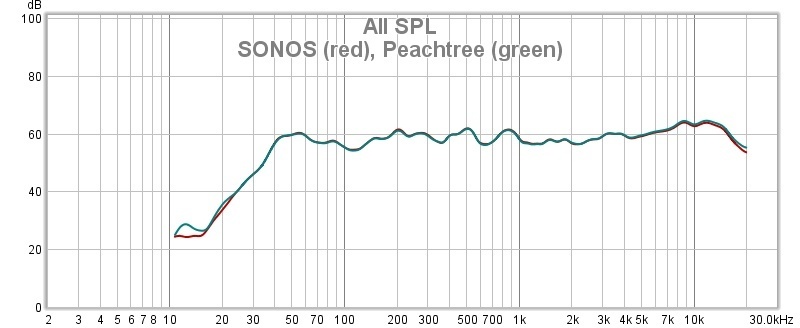


As you can see, the amps are almost identical. Ignore low frequencies - they vary from test to test even with the same amp below about 30Hz. At high frequencies, above about 4kHz, the Peachtree gets gradually brighter, ending up being about 1.5dB louder at 20kHz. This would be imperceptible to pretty much everyone.

Note that there is a slight increase in high frequencies above about 7kHz for both amps, so this could be the speakers. However, I think this is due to the frequency response of the microphone - the specifications show a similar slight increase.

Cheers, Peter.
    This topic has been closed for further comments. You can use the search bar to find a similar topic, or create a new one by clicking Create Topic at the top of the page.

    84 replies

    April 19, 2019
    Whatever the reason, the sound levels for the Sub and the main speakers would still have to be manually matched; and once that was done, this trait would have no impact on the sound from the set up compared to one without the Sub, other than the desired extension in low frequency response. Correct?
    Trending Lyricist II
    April 19, 2019
    Whatever the reason, the sound levels for the Sub and the main speakers would still have to be manually matched; and once that was done, this trait would have no impact on the sound from the set up compared to one without the Sub, other than the desired extension in low frequency response. Correct?
    Yes I think I agree with this. Some might want to use the main speakers full range, though, and set the sub filter within the sub controls. The only want to do this, as I understand it, is to connect to the sub with speaker level input.
    pwt
    Virtuoso
    April 19, 2019
    The Sonos Amp output voltage should just be input signal * gain, until clipping. If you remove low frequencies the amp's output in the pass-band should not change if the crossover filter has unity gain for the pass-band.

    You can prove to yourself that even a cheap amp is not affected by the presence of the low frequencies. In Audacity, import a clip with a good range of frequencies. Filter out the low end. Then listen to the filtered and unfiltered clips. The mids and highs will be played at the same level for both clips.

    None of this is incorrect, but nor does it refute what I stated. The Amp's gain is under software control, and the software can raise the gain for a given volume setting when there is no requirement to produce low frequencies.
    4 x P:5 | Sub | 4 x P:1 | 3 x Connect | 2 x Boost | Connect:Amp | 2 x One | Amp | Move | Port | Era 300
    Trending Lyricist II
    April 19, 2019
    Maybe I misunderstood what you were saying then. Possibly we are both just saying that the crossover adds gain (according to Peter's measurement). You think this might be intentional, whereas I think it is likely to be unintentional.
    April 19, 2019
    Some might want to use the main speakers full range, though, and set the sub filter within the sub controls. The only want to do this, as I understand it, is to connect to the sub with speaker level input.
    Yes. And there is someone struggling to achieve just this without a hum! See:
    https://en.community.sonos.com/components-228996/sonos-amp-and-high-level-input-from-subwooder-6822917
    pwt
    Virtuoso
    April 19, 2019
    Maybe I misunderstood what you were saying then. Possibly we are both just saying that the crossover adds gain (according to Peter's measurement). You think this might be intentional, whereas I think it is likely to be unintentional.
    Correct, I think it's intentional. The Amp has more headroom for gain when not required to produce low frequencies, so the Amp's software takes advantage of this. Amplifiers with simple manual controls typically cannot be run at 100% of dial volume without distortion, so one tends to assess by ear how loud they can be run, and one can increase the maximum volume setting if low frequencies aren't required. The Amp can be run at its 100% volume setting without distortion, so it makes sense to recalibrate via software control when the gain available increases.
    4 x P:5 | Sub | 4 x P:1 | 3 x Connect | 2 x Boost | Connect:Amp | 2 x One | Amp | Move | Port | Era 300
    Trending Lyricist II
    April 19, 2019

    Correct, I think it's intentional. .

    Do you mean that removing the low end is likely to result in a significantly lower peak amplitude in the output to the main speakers? I suppose that could be why they bump the gain. I'm not sure if that reasoning would hold true or not, I would think it would be dependent on what music is playing.
    pwt
    Virtuoso
    April 19, 2019
    Do you mean that removing the low end is likely to result in a significantly lower peak amplitude in the output to the main speakers?
    Yes, that's the gist of it.
    4 x P:5 | Sub | 4 x P:1 | 3 x Connect | 2 x Boost | Connect:Amp | 2 x One | Amp | Move | Port | Era 300
    Peter Mc
    Peter McAuthor
    April 21, 2019
    Audio amplifiers are essentially linear devices. They have to amplify each frequency by the same amount independent of other frequencies. If different frequencies interact, this is called non-linear distortion and is highly undesirable. It would mean, for example, that every C# on the trumpet, or every Bb on the bass would affect other frequencies. This doesn't happen to any noticeable extent. So filtering out the low frequencies should not affect any other frequencies. And it would be extremely unlikely to uniformly boost all other frequencies by exactly the same amount, i.e. 3 dB.

    My guess is that there is a bug in the DSP part of the Amp. The fact that the boost is exactly 3 dB suggests a coding error in the filtering software. It can be very easy to leave out a factor of 2. And a 3 dB boost is exactly double the power.

    Like kumar and lahey, I don't know what the point would be in deliberately boosting the non-filtered frequencies by 3 dB.

    Cheers, Peter.
    "The presence of those seeking the truth is infinitely to be preferred to those who think they've found it" - Terry Pratchett
    Peter Mc
    Peter McAuthor
    April 21, 2019
    p.s. I missed reading page 3 of this thread when posting just now. I can buy the argument that Sonos decided to use the additional headroom available when low frequencies are removed to make the Amp a bit louder. Of course, this will mean the lowest possible volume is also increased.
    "The presence of those seeking the truth is infinitely to be preferred to those who think they've found it" - Terry Pratchett