
Peter Mc
April 11, 2019

Amp freq response: Sonos vs Peachtree

  • April 11, 2019
  • 84 replies
  • 6698 views
There have been questions about the high frequency response of the Sonos Amp. User hodgeal posted a very interesting plot showing the frequency response of the Sonos Amp using the software REW. It didn't show excessive high frequencies in that single test.

I had the opportunity to compare the Sonos amp to my Peachtree amp using the same software (which is very useful and easy to use - thanks hodgeal), and this provides a comparative test of the Sonos Amp frequency response.

The Peachtree Nova 125 SE amp is well-respected in the audio community. It is a class D digital amp, same as the Sonos Amp, but as far as I can tell uses different chips. The test uses Duntech Marquis speakers and a Studio Projects C1 microphone. The mic is setup on-axis at a distance of 120cm, which is pretty standard. But none of the details should matter because this is a comparison under identical conditions - I simply swapped amps and repeated the test.

And the results?
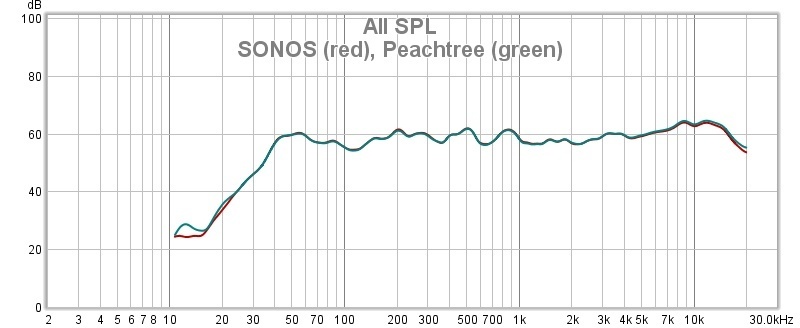


As you can see, the amps are almost identical. Ignore low frequencies - they vary from test to test even with the same amp below about 30Hz. At high frequencies, above about 4kHz, the Peachtree gets gradually brighter, ending up being about 1.5dB louder at 20kHz. This would be imperceptible to pretty much everyone.

Note that there is a slight increase in high frequencies above about 7kHz for both amps, so this could be the speakers. However, I think this is due to the frequency response of the microphone - the specifications show a similar slight increase.

Cheers, Peter.
    This topic has been closed for further comments. You can use the search bar to find a similar topic, or create a new one by clicking Create Topic at the top of the page.

    84 replies

    April 19, 2019

    Exactly. Manually, since in the case of a third-party sub, the Amp has no idea of its power output.

    But then once that is done, the 3dB boost the Peter refers to becomes a non issue. And no reason for a brighter sound.
    Trending Lyricist II
    April 19, 2019

    Isn't this just the Amp being able to deliver more power to the frequencies above the crossover, now that it doesn't also have to serve the frequencies below it?

    Ideally, an amplifier's output is simply the input signal multiplied by a gain factor. The output should not sag by having to provide the low end. That would mean it is a poor piece of equipment.
    pwt
    Virtuoso
    April 19, 2019

    Exactly. Manually, since in the case of a third-party sub, the Amp has no idea of its power output.

    But then once that is done, the 3dB boost the Peter refers to becomes a non issue. And no reason for a brighter sound.

    To be clear, I don't think it's an issue, nor does it indicate a brighter sound profile. I was just explaining why the Amp's volume at frequencies above crossover would be increased in the presence of a sub.
    4 x P:5 | Sub | 4 x P:1 | 3 x Connect | 2 x Boost | Connect:Amp | 2 x One | Amp | Move | Port | Era 300
    April 19, 2019

    To be clear, I don't think it's an issue, nor does it indicate a brighter sound profile.

    Right; over to Peter if he disagrees.
    pwt
    Virtuoso
    April 19, 2019

    Isn't this just the Amp being able to deliver more power to the frequencies above the crossover, now that it doesn't also have to serve the frequencies below it?

    Ideally, an amplifier's output is simply the input signal multiplied by a gain factor. The output should not sag by having to provide the low end. That would mean it is a poor piece of equipment.

    No-one said that the Amp 'sags'. It has to operate within a total power envelope with a gain that it can deliver across the required frequency range while meeting its target distortion values. Remove the requirement to amplify signals below the crossover and that total power envelope can be applied to a smaller frequency range, hence the remaining frequencies can benefit from higher gain.
    4 x P:5 | Sub | 4 x P:1 | 3 x Connect | 2 x Boost | Connect:Amp | 2 x One | Amp | Move | Port | Era 300
    Trending Lyricist II
    April 19, 2019

    No-one said that the Amp 'sags'. It has to operate within a total power envelope with a gain that it can deliver across the required frequency range while meeting its target distortion values. Remove the requirement to amplify signals below the crossover and that total power envelope can be applied to a smaller frequency range, hence the remaining frequencies can benefit from higher gain.

    The Sonos Amp output voltage should just be input signal * gain, until clipping. If you remove low frequencies the amp's output in the pass-band should not change if the crossover filter has unity gain for the pass-band.
    Trending Lyricist II
    April 19, 2019
    But what Peter found (I think) is that the sub crossover does change the gain. So it is not a unity gain implementation.
    Trending Lyricist II
    April 19, 2019
    You can prove to yourself that even a cheap amp is not affected by the presence of the low frequencies. In Audacity, import a clip with a good range of frequencies. Filter out the low end. Then listen to the filtered and unfiltered clips. The mids and highs will be played at the same level for both clips.
    April 19, 2019
    As I said earlier, I don't know enough about amp design to opine. But if the across the board uniform boost to frequencies - as Peter suggests is present when a Sub is in play - that are directed towards the speaker terminals of the amp is a design intent, what is the point of doing that?
    Trending Lyricist II
    April 19, 2019
    As I said earlier, I don't know enough about amp design to opine. But if the across the board uniform boost to frequencies - as Peter suggests is present when a Sub is in play - that are directed towards the speaker terminals of the amp is a design intent, what is the point of doing that?
    I don't know what the point would be. Maybe it is just a result of the signal processing that they do for the crossover, and they did not bother to correct for this.