
Peter Mc
April 11, 2019

Amp freq response: Sonos vs Peachtree

  • April 11, 2019
  • 84 replies
  • 6698 views
There have been questions about the high frequency response of the Sonos Amp. User hodgeal posted a very interesting plot showing the frequency response of the Sonos Amp using the software REW. It didn't show excessive high frequencies in that single test.

I had the opportunity to compare the Sonos amp to my Peachtree amp using the same software (which is very useful and easy to use - thanks hodgeal), and this provides a comparative test of the Sonos Amp frequency response.

The Peachtree Nova 125 SE amp is well-respected in the audio community. It is a class D digital amp, same as the Sonos Amp, but as far as I can tell uses different chips. The test uses Duntech Marquis speakers and a Studio Projects C1 microphone. The mic is setup on-axis at a distance of 120cm, which is pretty standard. But none of the details should matter because this is a comparison under identical conditions - I simply swapped amps and repeated the test.

And the results?
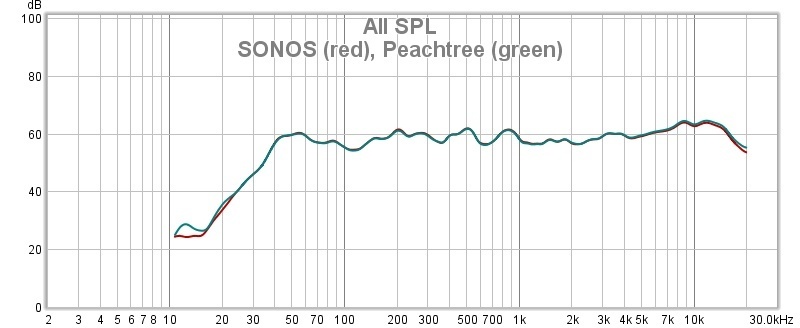


As you can see, the amps are almost identical. Ignore low frequencies - they vary from test to test even with the same amp below about 30Hz. At high frequencies, above about 4kHz, the Peachtree gets gradually brighter, ending up being about 1.5dB louder at 20kHz. This would be imperceptible to pretty much everyone.

Note that there is a slight increase in high frequencies above about 7kHz for both amps, so this could be the speakers. However, I think this is due to the frequency response of the microphone - the specifications show a similar slight increase.

Cheers, Peter.
    This topic has been closed for further comments. You can use the search bar to find a similar topic, or create a new one by clicking Create Topic at the top of the page.

    84 replies

    April 17, 2019
    I will, nevertheless, try this when I get a chance. Might be a few days.
    As far as what happens when the socket is plugged even by a blank plug, I would expect to see frequencies from the crossover downwards - after taking into account some slope - to disappear at the speaker terminals. That is all that the Amp is supposed to do; it should not, as alleged by some, also then mess around by boosting the higher frequencies. However what will happen is that the speakers, once a muddying effect of having to deliver the lower frequencies is removed, will do a better job of more accurately delivering the remaining frequencies. In the case of some speakers, this more accurate delivery may come across as brighter, or a more elevated treble, but it isn't the amp that is responsible for this by any boosting of the signal strength of the associated frequencies. And it is also likely that once the "burn in" period is over, this kind of more accurate sound delivery will become a preference.
    Peter Mc
    Peter McAuthor
    April 18, 2019
    Here are the results from plugging in an unconnected RCA cable to the Sonos Amp sub output:

    With no RCA connected, turning the Sub setting on or off in the app makes no difference.

    With an RCA connected, it DOES make a difference, and the crossover frequency also makes a difference. The low frequencies are reduced as expected, but as already described by hodgeal in the LS50 thread, the frequencies above the crossover are boosted by 3 dB.

    Plugging in an unconnected RCA does NOT turn on the sub setting in the app. This has to be done manually. I'm a bit surprised that the amp can sense the presence of an electrically inert plug, but that this information is not used to turn on the sub setting.

    Presumably Sonos can confirm that this is all as designed.

    Measurements below - all calibrated (mic, pre-amp, sound card). There are 3 curves underneath the dark blue - look at the very low frequencies. The green and pink do not mask any other curves. See the legend for which is which.


    Cheers, Peter.
    "The presence of those seeking the truth is infinitely to be preferred to those who think they've found it" - Terry Pratchett
    April 18, 2019

    With an RCA connected, it DOES make a difference, and the crossover frequency also makes a difference.

    the frequencies above the crossover are boosted by 3 dB.

    Plugging in an unconnected RCA does NOT turn on the sub setting in the app.

    First, to clarify: The change in the frequency response is seen by plugging in an unconnected RCA, regardless of the sub setting in the app?

    I am surprised that there is a boost applied to frequencies above the crossover; this isn't normal amp design for a sub line out. I suppose it is possible that this is not anything done by the amp, but by the speakers which are putting out higher sound levels by no longer having to deal with frequencies below the crossover?
    Peter Mc
    Peter McAuthor
    April 18, 2019
    First, to clarify: The change in the frequency response is seen by plugging in an unconnected RCA, regardless of the sub setting in the app?

    No. To get a change in the frequency response requires both plugging in the RCA lead and turning on the sub setting in the app. Doing just one of these changes nothing.

    I am surprised that there is a boost applied to frequencies above the crossover; this isn't normal amp design for a sub line out.

    It does seem unusual, although I've not had much to do with subs in the past.

    I suppose it is possible that this is not anything done by the amp, but by the speakers which are putting out higher sound levels by no longer having to deal with frequencies below the crossover?

    I can't imagine the speaker response to not having to reproduce low frequencies is to uniformly boost all other frequencies by exactly 3dB. It's too perfect. Besides, what would happen in songs where the bass and kick stop playing? I'm sure it's a design decision by Sonos. The exact same response was noted by hodgeal in the LS50 thread using very different speakers.

    Cheers, Peter.
    "The presence of those seeking the truth is infinitely to be preferred to those who think they've found it" - Terry Pratchett
    pwt
    Virtuoso
    April 18, 2019
    I am surprised that there is a boost applied to frequencies above the crossover; this isn't normal amp design for a sub line out. I suppose it is possible that this is not anything done by the amp, but by the speakers which are putting out higher sound levels by no longer having to deal with frequencies below the crossover?
    Isn't this just the Amp being able to deliver more power to the frequencies above the crossover, now that it doesn't also have to serve the frequencies below it?
    4 x P:5 | Sub | 4 x P:1 | 3 x Connect | 2 x Boost | Connect:Amp | 2 x One | Amp | Move | Port | Era 300
    April 19, 2019

    Isn't this just the Amp being able to deliver more power to the frequencies above the crossover, now that it doesn't also have to serve the frequencies below it?

    Do amps work like that? I don't know enough to say. But this would then apply to the amp in a play 1 unit as well. And what it would take to compensate is dialling down volume levels, not anything in the EQ. I don't notice any change in volumes - or treble levels for that matter - when I toggle the Sub on/off in my play 1 set up for which the same priniciple should apply. The midrange clears up subtly for the better with the Sub on, that's it.
    pwt
    Virtuoso
    April 19, 2019

    Isn't this just the Amp being able to deliver more power to the frequencies above the crossover, now that it doesn't also have to serve the frequencies below it?

    Do amps work like that? I don't know enough to say. But this would then apply to the amp in a play 1 unit as well. And what it would take to compensate is dialling down volume levels, not anything in the EQ. I don't notice any change in volumes - or treble levels for that matter - when I toggle the Sub on/off in my play 1 set up for which the same priniciple should apply. The midrange clears up subtly for the better with the Sub on, that's it.

    The P:1 has two separate amplifiers, and there's no relief for the tweeter amp when you introduce the Sub, so I wouldn't expect the overall volume to increase.

    In the case of the Amp, with a single amplifier configuration, it no longer has to supply energy for the frequencies below the crossover (which is current-heavy due to the large amount of air that has to be moved), so that energy can be redeployed to higher frequencies.
    4 x P:5 | Sub | 4 x P:1 | 3 x Connect | 2 x Boost | Connect:Amp | 2 x One | Amp | Move | Port | Era 300
    April 19, 2019
    Even so, a lot of the mid range on the play 1 is via the woofer; relieving it of low frequencies does not elevate the mid range dB.
    April 19, 2019
    The first reply to a question I posed, on hydrogen audio:
    "No boost is applied highpassed signal for the speakers.
    The sub has its own amp (active sub) and the sub has a volume control, so if configured correctly, the volume of the sub matches that of the speakers."
    In the play 1, I am guessing this happens by default. One can then change the relative levels via the Sub output settings. How would one match volume levels in the case of Sonos Amp, except manually?
    pwt
    Virtuoso
    April 19, 2019
    Even so, a lot of the mid range on the play 1 is via the woofer; relieving it of low frequencies does not elevate the mid range dB.
    It can't though, because there is no equivalent extra available power to elevate the high end (tweeter) to match. The total P:1 volume has to stay calibrated to within what the tweeter amp can deliver.

    How would one match volume levels in the case of Sonos Amp, except manually?
    Exactly. Manually, since in the case of a third-party sub, the Amp has no idea of its power output.
    4 x P:5 | Sub | 4 x P:1 | 3 x Connect | 2 x Boost | Connect:Amp | 2 x One | Amp | Move | Port | Era 300