
Peter Mc
April 11, 2019

Amp freq response: Sonos vs Peachtree

  • April 11, 2019
  • 84 replies
  • 6698 views
There have been questions about the high frequency response of the Sonos Amp. User hodgeal posted a very interesting plot showing the frequency response of the Sonos Amp using the software REW. It didn't show excessive high frequencies in that single test.

I had the opportunity to compare the Sonos amp to my Peachtree amp using the same software (which is very useful and easy to use - thanks hodgeal), and this provides a comparative test of the Sonos Amp frequency response.

The Peachtree Nova 125 SE amp is well-respected in the audio community. It is a class D digital amp, same as the Sonos Amp, but as far as I can tell uses different chips. The test uses Duntech Marquis speakers and a Studio Projects C1 microphone. The mic is setup on-axis at a distance of 120cm, which is pretty standard. But none of the details should matter because this is a comparison under identical conditions - I simply swapped amps and repeated the test.

And the results?
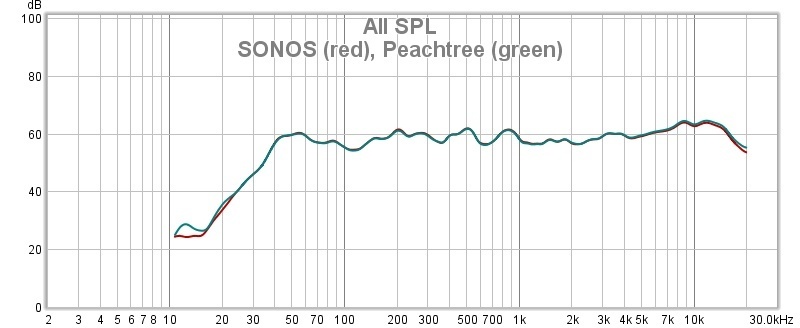


As you can see, the amps are almost identical. Ignore low frequencies - they vary from test to test even with the same amp below about 30Hz. At high frequencies, above about 4kHz, the Peachtree gets gradually brighter, ending up being about 1.5dB louder at 20kHz. This would be imperceptible to pretty much everyone.

Note that there is a slight increase in high frequencies above about 7kHz for both amps, so this could be the speakers. However, I think this is due to the frequency response of the microphone - the specifications show a similar slight increase.

Cheers, Peter.
    This topic has been closed for further comments. You can use the search bar to find a similar topic, or create a new one by clicking Create Topic at the top of the page.

    84 replies

    Enthusiast II
    April 14, 2019


    In any event, it's a bit silly to have loudness and sub turned on by default.


    Can other AMP owners confirm that the default settings after initial setup is indeed Loudness=ON?

    IIRC with the Connect and Connect:AMP the loudness is disabled by default.


    If I recall correctly, Loudness was enabled after initial setup both times I have set up an Amp.

    FWIW, I don't think the Amp is brighter than other amps. Mine replaced a Grace Design M920 + Hafler power amp. I did have to futz with the sub crossover and level when I switched to the Amp, but once I did, the setup up sounds the same to me.
    Trending Lyricist II
    April 14, 2019
    Thanks again Peter for your measurements. Something else occurred to me. The DDFA technology used in the Sonos Amp is known to have a high end frequency response that is load dependent. For example, see the curves below from measurements of the NAD M2, which also uses DDFA (from https://www.stereophile.com/content/nad-m2-direct-digital-integrated-amplifier-measurements). Now consider that real speaker impedance at high frequencies may be far from nominal 4 ohms or 8 ohms, and possibly the high end response could be somewhat variable with different speakers. So I wonder if this could partly explain what some reviewers are hearing.


    [Fig.2 NAD M2, 4 ohms speaker compensation, frequency response at 2.83V into: simulated loudspeaker load (gray), 8 ohms (left channel blue, right red), 4 ohms (left cyan, right magenta), 2 ohms (green). (2dB/vertical div.)
    Peter Mc
    Peter McAuthor
    April 15, 2019
    Now consider that real speaker impedance at high frequencies may be far from nominal 4 ohms or 8 ohms, and possibly the high end response could be somewhat variable with different speakers. So I wonder if this could partly explain what some reviewers are hearing.

    That's a really interesting thought. Presumably all amplifiers have to be able to handle the frequency-dependent impedance of a whole range of speakers. I seem to remember my Duntech Marquis have impedance ranging from 3-6 ohms (nominally 4 ohms) at different frequencies. If DDFA-based amps are more susceptible to this variable load, I can imagine there could be some issues. However, presumably all DDFA-based amps would be affected in a similar way. I'm not sure if this has come through in reviews of different brands. Of course there could always be design choices unique to Sonos that exacerbate the problem.

    Cheers, Peter.
    "The presence of those seeking the truth is infinitely to be preferred to those who think they've found it" - Terry Pratchett
    Trending Lyricist II
    April 15, 2019
    I seem to remember my Duntech Marquis have impedance ranging from 3-6 ohms (nominally 4 ohms) at different frequencies.

    Interesting. This fits what the M2 shows if we assume the Sonos Amp is dialed in for lower impedance. Then the amp might be a little bright with higher impedance speakers. I ordered some power resistors so maybe I can do some simple tests with dummy loads. But first I emailed Sonos to ask if they have any curves that they are able to share. I don't know if Sonos people are monitoring this thread and might chime in?

    DDFA uses some feedback taken right at the speaker connections and so I thought it would compensate for different loads. But the M2 tests seem to show that this might only work well over a limited range of loading. Maybe Qualcomm has improved this with newer DDFA technology?
    April 17, 2019
    Peter, if you can answer this after measurements, questions that arose in another thread:

    What happens at the speaker terminals of the Sonos Amp if a blank jack is plugged into the Sub out jack? Are the speaker terminals then denied frequencies below the crossover setting of 80Hz even if there is nothing at the other end of the jack? And then does turning the Sub on/off in room settings for the Sonos amp in the Sonos app have any impact on what happens at the speaker terminals? Are low frequencies restored to the speaker terminals with the jack plugged in, but the Sub setting on off?
    April 17, 2019
    Peter many thanks for the measurements and the super informative analysis. Very very interesting indeed 🙂. If (big IF) that frequency response is carried over to other setups then I wonder whether the measured relative rise at 6kHz and above is partly responsible for the perceived brightness of the amp? I also understand you suggest that this rise is due to the mic frequency response. Difficult to reach a conclusion on how this measured response will correlate with perceived sound of course but if we assume this is what reaches the ear then it is worth noting that in your case we can observe a rise that reaches about +3dB at 8 - 9 kHz. To quote my sound engineer friend, this is the 'presence - sibilance' range. In contrast we see a drop of about -5dB in the 1-3 kHz range which is in the vocal range. Comparing the two we can consider a total of 8db relative difference between the vocal range and the sibilance - presence range which may lead to a perceived sound 'flavour' as the reviews describe? Having said that, the peachtree shows a very similar frequency response in your setting so no big difference there. Of course this response is very context dependent (speakers + Room acoustics) so difficult to draw conclusions.

    In my case, I immediately felt I had to turn down the treble of the Sonos Amp by 3-4 clicks as soon as I started listening to it. I did turn off the loudness before listening. The 's' sounds felt very pronounced to my ears. This was at my dealer's listening room with a pair of Dynaudio M10 speakers which I also have at home. This does not necessarily mean the amp is bright for everyone though. I know I am very very sensitive to frequencies from 3kHz and above and I usually adjust these down if I can. This is probably the reason why I always the Sonos Trueplay results in a very uncomfortable sound for my ears and can never use it (sadly). Once I adjusted the Sonos Amp treble it was sounding fine 🙂
    Peter Mc
    Peter McAuthor
    April 17, 2019
    What happens at the speaker terminals of the Sonos Amp if a blank jack is plugged into the Sub out jack?
    I cannot imagine the Amp would even know a blank RCA plug was connected. There would be no impedance change for it to sense. Unless there is a physical switch sensing the centre prong. I will, nevertheless, try this when I get a chance. Might be a few days.
    "The presence of those seeking the truth is infinitely to be preferred to those who think they've found it" - Terry Pratchett
    Peter Mc
    Peter McAuthor
    April 17, 2019
    ... I wonder whether the measured relative rise at 6kHz and above is partly responsible for the perceived brightness of the amp? I also understand you suggest that this rise is due to the mic frequency response.
    I can now confirm the rise is due to the mic. I obtained generic calibration data for the mic, and also calibrated the pre-amp/sound-card combination (which was small). The results are below. The top plots include the calibrations, the bottom ones don't (see the legend). The plots have been separated by 10 dB for clarity.


    I have seen a number of people mention that they find class D amps bright. My analysis shows that there is very little difference between the Sonos Amp and the well-respected Peachtree. I haven't seen anyone complain specifically about the Peachtree being bright. But you may find all class D amps sound bright. It would be interesting if you could audition another brand of class D amp.

    Cheers, Peter.
    "The presence of those seeking the truth is infinitely to be preferred to those who think they've found it" - Terry Pratchett
    April 17, 2019

    I can now confirm the rise is due to the mic.

    LOL. That will put a cat among some of the pigeons...but it does not surprise me that either the mic or the speakers were the cause. Of course your test establishes that if the Sonos Amp is bright, so is the Peachtree, changes between the two being the only variable. I believe that the thing about each interacting differently with the load is a red herring. I also do not think that Sonos will put a bright amp on the market, not having done that with the Connect Amp years ago.

    The only mystery is of a reliable poster who claims that he found it bright, power recycled it once, and then it was fine. So there may be something in the DSP that is acting up in some cases. Perhaps.

    As to my Sub question, I believe it is a physical sensing of some kind. That must be why Sonos recommends that the jack be pulled out if the Sub is disconnected. A recommendation carried forward from the Connect Amp.
    April 17, 2019
    ... I wonder whether the measured relative rise at 6kHz and above is partly responsible for the perceived brightness of the amp? I also understand you suggest that this rise is due to the mic frequency response.
    I can now confirm the rise is due to the mic. I obtained generic calibration data for the mic, and also calibrated the pre-amp/sound-card combination (which was small). The results are below. The top plots include the calibrations, the bottom ones don't (see the legend). The plots have been separated by 10 dB for clarity.


    I have seen a number of people mention that they find class D amps bright. My analysis shows that there is very little difference between the Sonos Amp and the well-respected Peachtree. I haven't seen anyone complain specifically about the Peachtree being bright. But you may find all class D amps sound bright. It would be interesting if you could audition another brand of class D amp.

    Cheers, Peter.


    Many thanks for this extra test Peter, very interesting indeed. I have not listened to many class d amps but the Bluesound Powernode I briefly tested a while back (with same Dynaudio M10 speakers) was fine, smooth sounding and not bright at all. To my ears It did not sound better or worse than the Sonos amp (after treble adjustment on the latter). No personal experience with the peachtree but it does indeed have a stellar reputation. I have also come across people's opinions regarding class d amps in general. Not sure if the older generations were a bit prone to sound quality problems but I think the later / latest generations of digital amps are trouble free 🙂.