
Peter Mc
April 11, 2019

Amp freq response: Sonos vs Peachtree

  • April 11, 2019
  • 84 replies
  • 6698 views
There have been questions about the high frequency response of the Sonos Amp. User hodgeal posted a very interesting plot showing the frequency response of the Sonos Amp using the software REW. It didn't show excessive high frequencies in that single test.

I had the opportunity to compare the Sonos amp to my Peachtree amp using the same software (which is very useful and easy to use - thanks hodgeal), and this provides a comparative test of the Sonos Amp frequency response.

The Peachtree Nova 125 SE amp is well-respected in the audio community. It is a class D digital amp, same as the Sonos Amp, but as far as I can tell uses different chips. The test uses Duntech Marquis speakers and a Studio Projects C1 microphone. The mic is setup on-axis at a distance of 120cm, which is pretty standard. But none of the details should matter because this is a comparison under identical conditions - I simply swapped amps and repeated the test.

And the results?
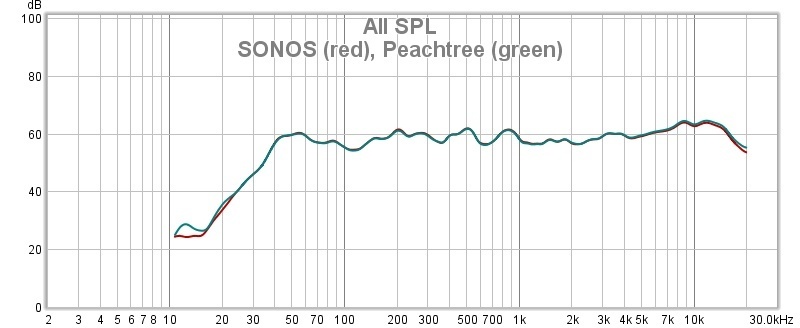


As you can see, the amps are almost identical. Ignore low frequencies - they vary from test to test even with the same amp below about 30Hz. At high frequencies, above about 4kHz, the Peachtree gets gradually brighter, ending up being about 1.5dB louder at 20kHz. This would be imperceptible to pretty much everyone.

Note that there is a slight increase in high frequencies above about 7kHz for both amps, so this could be the speakers. However, I think this is due to the frequency response of the microphone - the specifications show a similar slight increase.

Cheers, Peter.
    This topic has been closed for further comments. You can use the search bar to find a similar topic, or create a new one by clicking Create Topic at the top of the page.

    84 replies

    April 13, 2019
    Peter,
    One that talks about the effect of the loudness thing:
    https://www.whathifi.com/reviews/sonos-amp

    One that says it is bright and claims that this is also how other reviews have found it:

    https://www.theverge.com/2019/3/7/18254803/sonos-amp-review-speaker-specs-features-price

    Another one that says the same about brightness:

    https://www.soundandvision.com/content/sonos-amp-streaming-amplifier-review-page-2

    No surprise, none have any measurements attached.

    I suspect that posters here that say the same thing have read these and other such reviews and been influenced by these. There is nothing to be said about one poster that found it bright, but found that burning in takes care of that:-).

    As to the loudness thing - the usual design for that is to boost the lower mid to low side of things at low sound levels to bring back some depth/richness to the sound that is otherwise missing at those levels. This boost tapers off as sound levels approach 50%. Treble is usually not boosted by the loudness switch. I have no idea how Sonos has built this function for the Sonos Amp.
    April 13, 2019

    Can other AMP owners confirm that the default settings after initial setup is indeed Loudness=ON?

    At least one of the reviews I linked confirms this.
    Peter Mc
    Peter McAuthor
    April 13, 2019
    Peter,
    As to the loudness thing - the usual design for that is to boost the lower mid to low side of things at low sound levels to bring back some depth/richness to the sound that is otherwise missing at those levels. This boost tapers off as sound levels approach 50%. Treble is usually not boosted by the loudness switch.


    I disagree. The usual design of a loudness switch is to boost both bass and treble. The reason is that human hearing is less sensitive in both the bass and treble frequencies at low volumes. This has been traditionally demonstrated by the "Fletcher-Munson curves", although I believe they have been superseded by the similar "Equal-loudness contours".

    Cheers, Peter.
    "The presence of those seeking the truth is infinitely to be preferred to those who think they've found it" - Terry Pratchett
    April 13, 2019
    Does your graph allow you to see what Sonos actually does via loudness?

    See this for my understanding:

    "The most famous, well-used measurement for plotting our perception of loudness against the frequency of tones is the Fletcher-Munson curve(s) of equal loudness, published in 1933. The graphs were updated in 1956 by D.W. Robinson and R.S. Dadson. They were refined again in 2003 and adopted by the International Standards Organization as ISO 226. The purpose of the graph is to show that for humans to consider two pitches equally loud, the amount of energy necessary to produce the tone at one frequency may be completely different than at another. The multiple lines, spaced in 10 dB increments, also show that the energy/frequency differences are steeper at lower intensity levels and flatten out at extremely high intensities, though not quite as much as Fletcher and Munson first determined.
    The "loudness button" on a stereo amplifier is intended to boost bass frequencies at lower volume levels where the curve is the steepest."

    Perhaps it is the 2003 revision that drives the boost to just the bass frequencies. In my listening as well, the impression conveyed by the loudness switch is a higher presence of the lower end at low volumes. But it would be interesting to see what a measurement shows, for Sonos.

    It is quite possible that my ears don't hear much treble in the first place, for the increase to be noticed!
    April 13, 2019
    I see that the other LS50 thread has a graph that shows what the loudness toggle on Sonos Amp does and it shows a noticeably higher boost at the low end compared to that at the treble end.
    That's at 50% volume levels; I wonder how it would look at the 20% mark.
    Peter Mc
    Peter McAuthor
    April 14, 2019
    Here are graphs of the effect of the loudness control on the Sonos Amp at volumes of 25%, 50% and 75%. The legend indicates which plot is which, but it should be fairly clear. The largest effect is at 25% volume, where the bass is boosted by about 5dB and the treble by about 2.5 dB. At a volume of 50% the effect is roughly halved. At a volume of 75% the loudness control has no effect. The reason there is more boost to the bass than the treble is because our ears lose sensitivity at low volumes more at bass frequencies than at treble frequencies (still true for Equal loudness ISO 226:2003 curves).


    Again, note that it is only differences that are meaningful in this plot. Pairs of lines at the same volume have been shifted vertically for clarity, and as discussed earlier, a single line includes the effect of the speaker and microphone (as well as mic pre-amp and sound card response, room effects at low frequencies etc).

    Cheers, Peter.
    "The presence of those seeking the truth is infinitely to be preferred to those who think they've found it" - Terry Pratchett
    April 14, 2019
    Very nice, thank you!
    I see that there are two lines for 75%, but are seen as one because they overlap completely?
    This bears out what I hear in other Sonos units - a palpable elevation of bass and even some vocals, and I expect that I don't hear the smaller boost to the treble given my already age affected hearing of those frequencies. And because a lot of my music is low/midrange dominated jazz, with vocals not being the opera/soprano kind.
    I am little surprised to see that at 50%, which is moderately loud where my play units are concerned, there is still a significant effect of the loudness toggle and that it takes levels to be as high as 75% for it to vanish.
    Peter Mc
    Peter McAuthor
    April 14, 2019
    I see that there are two lines for 75%, but are seen as one because they overlap completely?

    Correct.

    I am little surprised to see that at 50%, which is moderately loud where my play units are concerned, there is still a significant effect of the loudness toggle and that it takes levels to be as high as 75% for it to vanish.

    Agreed. I would rarely listen at this level.

    The volume taper used by Sonos is quite different to most amps. My Peachtree reached very high volumes at about 20%, but didn't change as much thereafter. The Sonos Amp is just warming up at 50%, but gets much louder after that. I have run it at 100%, and was surprised at the lack of any distortion. I never ran the Peachtree at 100%, but I probably could have. Just wasn't game!

    Cheers, Peter.
    "The presence of those seeking the truth is infinitely to be preferred to those who think they've found it" - Terry Pratchett
    April 14, 2019

    The volume taper used by Sonos is quite different to most amps.

    It is more honest and therefore makes the volume control useable across the entire range of its motion, allowing for finer control at the lower end unlike most amps of today that seek to sound more powerful by very quickly reaching peak distortion free sound levels.
    April 14, 2019
    Peter, see the linked review page that has the most detailed comments in elaboration of the brightness finding. Strangely enough, the reviewer did not see this go away by toggling Loudness to off, but by a radical reduction of treble in the EQ control.

    Of course the review also talks about things like the amp being more dynamic than another, to the preference of the reviewer. What dynamic means is a mysterious part of the equally mysterious PRAT attributes of amplifiers that some reviewers love to talk about: Pace, Rhythm, Attack, and Timing.

    https://www.cnet.com/reviews/sonos-amp-review/2/