
Peter Mc
April 11, 2019

Amp freq response: Sonos vs Peachtree

  • April 11, 2019
  • 84 replies
  • 6698 views
There have been questions about the high frequency response of the Sonos Amp. User hodgeal posted a very interesting plot showing the frequency response of the Sonos Amp using the software REW. It didn't show excessive high frequencies in that single test.

I had the opportunity to compare the Sonos amp to my Peachtree amp using the same software (which is very useful and easy to use - thanks hodgeal), and this provides a comparative test of the Sonos Amp frequency response.

The Peachtree Nova 125 SE amp is well-respected in the audio community. It is a class D digital amp, same as the Sonos Amp, but as far as I can tell uses different chips. The test uses Duntech Marquis speakers and a Studio Projects C1 microphone. The mic is setup on-axis at a distance of 120cm, which is pretty standard. But none of the details should matter because this is a comparison under identical conditions - I simply swapped amps and repeated the test.

And the results?
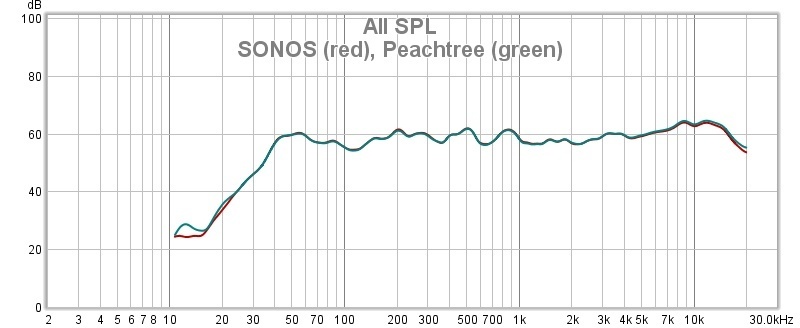


As you can see, the amps are almost identical. Ignore low frequencies - they vary from test to test even with the same amp below about 30Hz. At high frequencies, above about 4kHz, the Peachtree gets gradually brighter, ending up being about 1.5dB louder at 20kHz. This would be imperceptible to pretty much everyone.

Note that there is a slight increase in high frequencies above about 7kHz for both amps, so this could be the speakers. However, I think this is due to the frequency response of the microphone - the specifications show a similar slight increase.

Cheers, Peter.
    This topic has been closed for further comments. You can use the search bar to find a similar topic, or create a new one by clicking Create Topic at the top of the page.

    84 replies

    April 23, 2019
    Does this then bring to light an undisclosed feature of the Amp? That it will deliver sound levels that are higher across the board by 20-30% if bonded with the Sonos Sub or with a third party Sub of similar power? That is no trivial feature to have. And I don't think that too many legacy HiFi amps can boast of this capability; all they can claim is what comes from the Sub - frequency extension at the lower end.
    April 23, 2019
    Which lead me too: this feature would be even more welcome in the Connect Amp, which is just 55 wpc, and could better use a boost in overall sound levels. I am pretty sure it isn't implemented there, from memory; my Sub is with the play 1 these days. I see no reason why it can't be implemented there, other than the usual prioritisation constraints. And of course, the fact that it is a superseded product.
    Trending Lyricist II
    April 23, 2019
    This is interesting, so I imported some music into audacity to see how much headroom is created by high-pass filtering. I'm finding that it isn't much, only a few tenths of a dB typical even with a 100hz filter. So I am not convinced that there is good reason for the 3dB bump that Sonos uses with the crossover. Try it yourself; here is how to find the peak level in audacity:

    http://think3x.com/audio/2014/09/02/audacity-effects-amplify-5-finding-peak-amplitude/
    April 23, 2019
    But isn't this before the volume control has been recalibrated as Sonos has apparently done - I suppose your finding above is with some other amp?
    Trending Lyricist II
    April 23, 2019
    But isn't this before the volume control has been recalibrated as Sonos has apparently done - I suppose your finding above is with some other amp?
    What I was doing with audacity was just filtering a music file, nothing really specific to the amp. I was just trying to see if high-pass filtering creates enough headroom to justify bumping gain with a sub crossover. I'd be interested to see what others find.
    April 23, 2019
    Perhaps a stupid question: how would you see this headroom unless the volume control was recalibrated as Sonos seem to have via software for the Sonos Amp? But I agree that we need to see other responses.
    Trending Lyricist II
    April 23, 2019
    I was comparing peak amplitude before and after the filtering. The link I provided shows how to do this in Audacity. I was using jazz and classical music samples from 2L. I wouldn't be surprised if other types of music gave different results.
    Trending Lyricist II
    April 23, 2019
    Something I find interesting... if you apply a 100Hz high pass filter to some modern popular music files, the peaks actually increase. So files with peaks just shy of 0dB go into clipping. If you attenuate the original file by 3dB, then HP filter it, you can see that the peaks actually increase by quite a bit. All of this convinces me that there is no reason for Sonos to a apply a 3dB bump with their sub crossover.

    Peter - sorry if we (especially me) are derailing your thread!
    Peter Mc
    Peter McAuthor
    April 24, 2019
    Something I find interesting... if you apply a 100Hz high pass filter to some modern popular music files, the peaks actually increase. So files with peaks just shy of 0dB go into clipping. If you attenuate the original file by 3dB, then HP filter it, you can see that the peaks actually increase by quite a bit. All of this convinces me that there is no reason for Sonos to a apply a 3dB bump with their sub crossover.
    I think you have discovered the Gibbs Phenomenon. Some people refer to this as "overshoot", and it is related to "ringing". Usually it is observed when low-pass filtering, but it can also happen with a high-pass filter. If the filter has too high a Q factor (i.e. it is a steep filter), there can be overshoot for frequencies close to the filter cutoff. The first plot below shows the Sonitus EQ in Cakewalk by Bandlab (used to be Sonar, similar program to Audacity). It has a Q of 1.6 and simply cuts out low frequencies. The second plot pushes the Q up to 3, which boosts some frequencies while still cutting out most of the low ones.


    Peter - sorry if we (especially me) are derailing your thread!
    No worries - it's all interesting discussion.
    "The presence of those seeking the truth is infinitely to be preferred to those who think they've found it" - Terry Pratchett
    April 24, 2019
    Does this then bring to light an undisclosed feature of the Amp? That it will deliver sound levels that are higher across the board by 20-30% if bonded with the Sonos Sub or with a third party Sub of similar power? That is no trivial feature to have. And I don't think that too many legacy HiFi amps can boast of this capability; all they can claim is what comes from the Sub - frequency extension at the lower end.
    So, does anyone want to take a shot at answering this?