Atom P
Sonos Staff
April 8, 2026
Tutorial

Sonos + UniFi: Best Practices & Recommended Settings

  • April 8, 2026
  • 106 replies
  • 9464 views

Hello, everyone! I want to share some insights regarding Sonos setups in Ubiquiti UniFi environments. We see common questions and suggestions around how best to use Sonos with UniFi networks, and I wanted to give you the inside scoop on how we approach this troubleshooting. Unifi already has a solid guide on Sonos that we recommend checking out here, but we wanted to expand upon this.

We know that UniFi gear is incredibly popular among our power users (and many of us internally!). While Sonos is designed to work on standard home networks out of the box, managed networks like UniFi offer a level of control that can sometimes inadvertently block the communication Sonos needs to keep your system in sync.

To be clear, home networking is complex and every environment is unique. However, based on our internal documentation and successful troubleshooting sessions, here are the configurations we recommend to keep your music playing without interruption.


Disclaimer. This article is up to date through April 2026. Some settings might have changed since we first made this article.

June 2026 Update: The Sonos app now gives users the ability to disable SonosNet across their entire Sonos system. Take a look at ​@Liz P.’s update post for more info!


The "Golden Rule": Wired vs. Wireless


One of the most common causes of network storms/loops is a mixed environment where some Sonos players are wired and others are wireless, combined with conflicting Spanning Tree Protocol (STP) settings.

For the most stability, we generally recommend one of two approaches:

  • Fully Wireless: All Sonos products connect directly to your UniFi WiFi. 
    • This is often the easiest setup for modern Sonos products like Era 100/300, Move, and Roam.
  • Fully Wired: All capable Sonos products are Ethernet-wired.
    • WiFi is manually disabled on each player via the Sonos app.

If you are using a "Mixed" setup (some wired, some wireless using SonosNet), you must configure your STP settings correctly on your switches to avoid packet storms. (See the "Spanning Tree" section below).


Troubleshooting: "Missing Rooms" or Grouping Issues


If you are seeing speakers disappear from the Sonos app, or if you group rooms but audio only plays from one speaker, check that Multicast traffic is not being blocked or filtered and IGMP snooping is enabled.

Here are the settings we recommend checking in your UniFi Network Controller. Note: Menus may vary slightly depending on your Controller version.

  1. Check the basics: Ensure the controller (your phone) and the system are on the same subnet/VLAN.
  2. Verify the "Disable" list: Go back to the WiFi settings above and triple-check that Multicast and Broadcast Control and Multicast Enhancement are turned off. 
  3. Re-Provision: After changing these settings, allow a minute for the Access Points to re-provision. It is often helpful to reboot the Sonos players after the network settings have been applied to clear any stale connection states.

Unifi WiFi & Network Settings for Sonos


TL;DR: Disable Multicast Enhancement, Broadcast Control, and Client Isolation

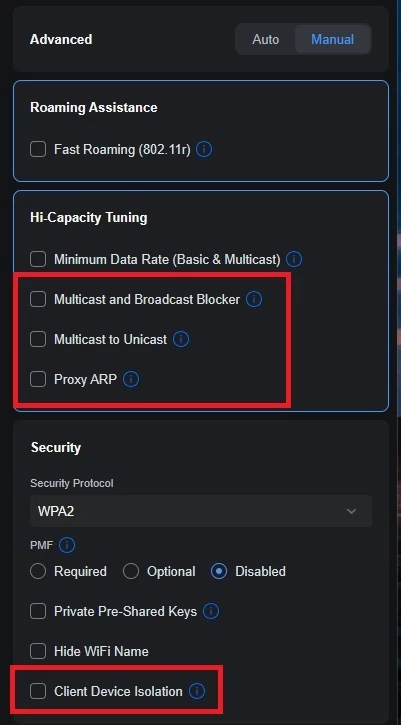
Go to Settings > WiFi and select your WiFi name. Change Advanced Configuration to Manual to verify the following:

  • Hotspot 2.0: Set to Off. 
  • Multicast to Unicast (previously called “Multicast Enhancement”): Disabled (unchecked). Note: While this sounds like something you’d want on, it converts multicast to unicast, which can cause issues with Sonos grouping.
  • Multicast and Broadcast Control: Disabled (unchecked). This blocks multicast traffic for non-listed devices and is a common culprit for missing players.
  • Client Device Isolation: Disabled (unchecked). This prevents devices on the same AP from talking to each other.
  • Proxy ARP: Disabled (unchecked).

Global Network Settings


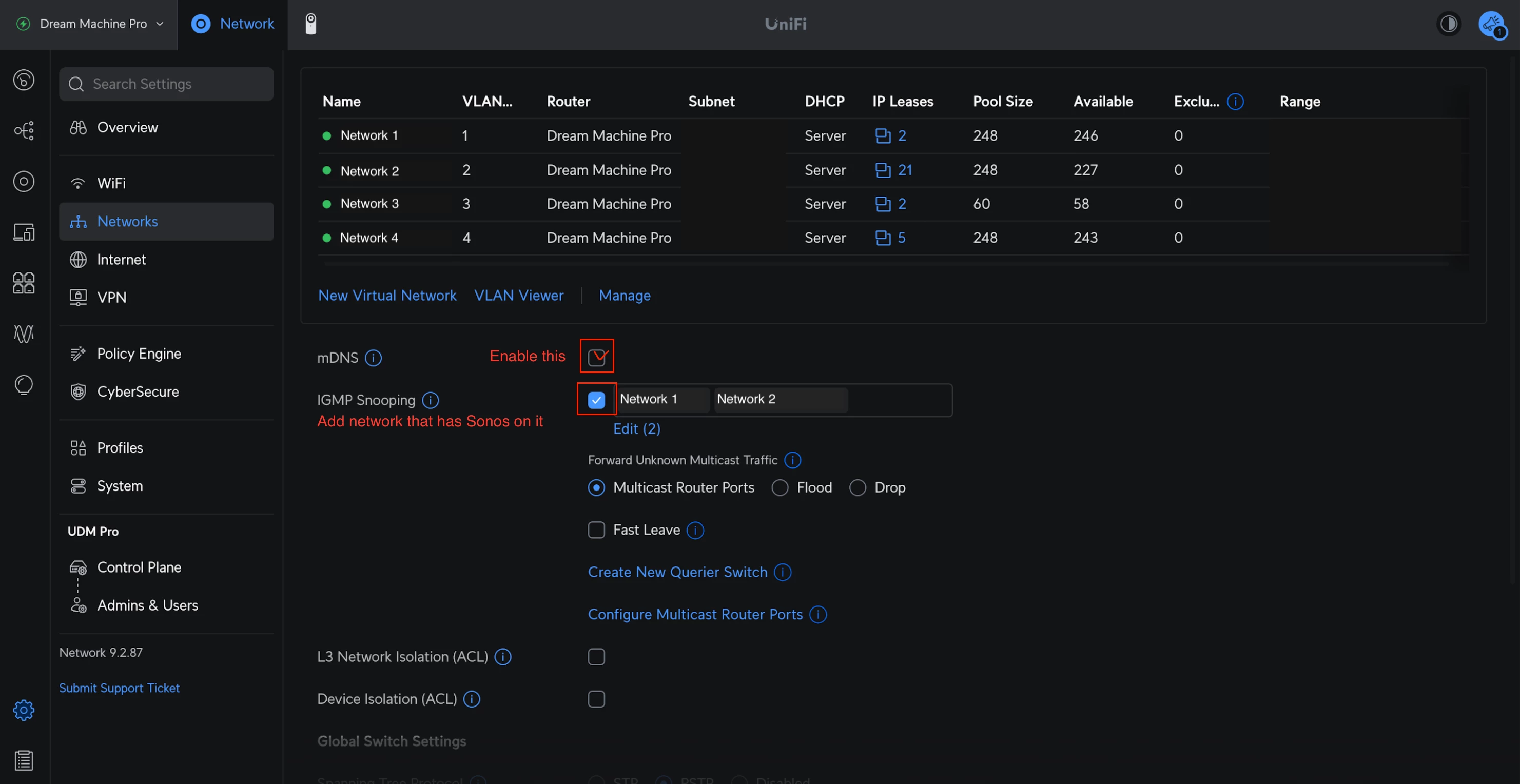
TL;DR: mDNS: Enabled, IGMP Snooping: Enabled

Go to Settings > Networks and select the network Sonos uses:

  • IGMP Snooping: Enabled. This helps reduce unnecessary multicast traffic while ensuring the right packets get to your speakers.
  • mDNS: Enabled. Technically speaking, this helps with device discovery. However, if you are running a complex setup with separate Sonos systems on different VLANs, mDNS might actually need to be disabled—but for 99% of home users, keep this ON.
Spanning Tree Protocol (STP) Settings


If you have any Sonos devices wired to your network (without disabling WiFi), you must configure STP on your UniFi switches to prevent network loops. Sonos uses STP (802.1d) to figure out the best path for data.


Global Switch Settings


TL;DR: STP switch priority 4096/8192/12288.

  • Spanning Tree: Select STP (not RSTP).
  • Priority: Set your core/main switch to 4096.
    • If you have secondary switches daisy-chained, set them to 8192.
    • Tertiary switches should be set to 12288.

Port Specific Settings: For the specific ports where a Sonos device is plugged in:

  • STP: Enabled
  • Edge Port: Auto or Enabled
  • BPDU Guard: Disabled
  • Root Guard: Disabled
  • Path Cost: 10
  • Port Priority: 128

Final Thoughts


I hope this helps clarify the best way to harmonize Sonos with UniFi gear. We know some of you have sophisticated home networks, and we want to ensure our products play nicely with them.

I'm happy to answer questions about these specific settings to the best of my ability. If you have a specific topology that defies these rules, let us know in the comments—we love seeing how you all set things up!

106 replies

Contributor I
August 30, 2026

Hello, great work on this tutorial. From what I understand you are aiming on bigger instalations with multiple AP?

Have anybody looked at RSSI thresholds?

I do have Cisco network at home, it was a pain to set everything at start, as I opted for wired connection where it was possible, what a novice mistake….. :D . But after disabling wifi everywhere. Things went well.

Few days ago some stutters ocured in my setup.

I found out that the master device (wirelles “Bathroom”, as if I corectly understand master is the one which is the closest to start of alfabet) have noncosistend network latency with spikes to 200ms and more. 


Today I checked signal from APs and found out that speaker is connected to AP with on 5GHz, 80MHz band width with rssi -60dbm, even tho there is another AP on 5GHz, 40MHz band width with rssi -45dbm. And found out that another speaker is the same but -69dbm vs -63dbm. I do have any roaming “help” protocols turned off on network.

Any knowledge on this topic?

Stanley_4
Grand Maestro
August 30, 2026

Disabling the Sonos radio, which is what disable Wi-Fi actually does, is usually a bad idea. It is particularly bad for Home Theater Rooms where it disables the low latency 5 gHz network needed for synchronized Sub and Surround sound.

Much better to leave the radio on and disable Sonosnet which simplifies things without breaking anything.

Contributor I
August 30, 2026

Thank you, but my beam gen2, sub gen3 and amp are working flawless, all wired, with wifi turned off, and sonosnet turned off about 5ms after this option was available :D.

To be honest… there is no way 5GHz wifi standard is faster than good old ethernet cable….

But that is not my question.


jgatie
August 30, 2026

Thank you, but my beam gen2, sub gen3 and amp are working flawless, all wired, with wifi turned off, and sonosnet turned off about 5ms after this option was available :D.

To be honest… there is no way 5GHz wifi standard is faster than good old ethernet cable….

But that is not my question.


It's not 5GHz wifi standard.  It's a custom, ad-hoc, one-way, direct connection between soundbar and the subs/surrounds.  Unlike Ethernet, the direct connection skips the hops required to traverse the network to the router and back to the surrounds/Subs, so yes, in general it is found to be more reliable than Ethernet for the low latency required for synching with video. The fact Ethernet works for you probably means the number of hops for your setup are a bare minimum and do not cause dropouts.

buzz
Grand Maestro
August 30, 2026

If there are any network switches, make sure that each has a different priority. The primary should have the lowest priority.

Stanley_4
Grand Maestro
August 30, 2026

Thank you, but my beam gen2, sub gen3 and amp are working flawless, all wired, with wifi turned off, and sonosnet turned off about 5ms after this option was available :D.

To be honest… there is no way 5GHz wifi standard is faster than good old ethernet cable….

But that is not my question.


As above, I said nothing about 5 gHz wifi, only the Sonos hidden - not quite wifi - 5 gHz Home Theater network.

If you read past posts here you will see a number of users discussing issues with wired Sub and Surrounds. You might even find something from me, taking your position and being proven wrong when the issues I was having went away when I disconnected Ethernet from all but primary Sonos devices.

Working well now with a only a few primary devices wired (For no good reason past, well the wire was rignt tnere so why not.) and Sonosnet disabled, the rest are on my Wi-Fi with the Sonos HT 5 gHz networks available. No radios needed to be disabled, which matches the official Sonos guidance.

Contributor I
August 31, 2026

Again. That was not my question….. My system is functioning well. Just curious, can you post me a source with “bonding” functionality? Just to make it clear for me. THX


Back to my original question, how is it with roaming with these speakers? Cause I clearly have better signal on other AP but they do not roam.

Stanley_4
Grand Maestro
August 31, 2026

Sonos doesn't have anything on the Bonding deails in the support FAQ that I could find, might be in one of the other sections.

Unless your network is forcing connections Sonos should connect to the strongest AP. Double-check that  and if there is  nothing doing that submit a diwg ostic and call support.


buzz
Grand Maestro
August 31, 2026

With respect to surrounds and SUB, they are in the same room as the soundbar, maybe not with an AMP.   Unless AMP is too distant, the direct 5GHz connection will almost always be the best approach because it bypasses network congestion. In rare cases when there is significant 5Ghz interference, wired might be better, but since 5GHz range is limited, this is unusual.

Local Superstar
August 31, 2026


Today I checked signal from APs and found out that speaker is connected to AP with on 5GHz, 80MHz band width with rssi -60dbm, even tho there is another AP on 5GHz, 40MHz band width with rssi -45dbm. And found out that another speaker is the same but -69dbm vs -63dbm. I do have any roaming “help” protocols turned off on network.

Any knowledge on this topic?

The Wi-Fi client is responsible for making roaming decisions, and can be nudged by the AP. You need to be careful, as the client may want to revert back after being nudged by the AP.

In your example above the RSSI is above the minimum threshold for the client to trigger a roam event. 

Not sure why you have 80MHz bands mixed with 40MHz? I use 20MHz for 2.4GHz, and 40MHz for 5GHz.


I found out that the master device (wirelles “Bathroom”, as if I corectly understand master is the one which is the closest to start of alfabet) have noncosistend network latency with spikes to 200ms and more. 

When you say ‘master’ you mean group coordinator? I suspect you started a stream on bathroom, then group other speakers to bathroom? That may not have been optimum for your network configuration. Maybe start the stream on a wired speaker, and add bathroom to group?

200ms latency suggests something wrong with the network configuration.


To be honest… there is no way 5GHz wifi standard is faster than good old ethernet cable….

A properly configured 5GHz Wi-Fi, even with 40MHz channel width, is many times faster than 100Mbs FE network.