
Ryan S
Retired Sonos Staff
January 21, 2020

End of Software Updates for Legacy Products
Related content:Software
End of Software Updates for Legacy Products

Please note that we’ve created a new thread with some clarifications to questions that have come up several times in this thread. Please see here to continue the discussion if you still have any questions. The information contained in this thread is outdated and may no longer be accurate.


We have some important news regarding our oldest Sonos devices shared on the Sonos Blog today. The text of that blog post is being included here for your convenience:


Starting in May 2020, some of our oldest products will no longer receive software updates or new features. We want to explain why and your options. 

When we first set out almost 20 years ago to invent the technology to easily listen to any song in any room, most of the ways we listen to music today did not exist. In fact, the first Sonos products were introduced before the first iPhone was announced and when Myspace still ruled social media. 


In order to invent multi-room music and smart speakers, we combined the worlds of high-fidelity audio and computing. Every Sonos product has a microprocessor, flash memory, and other hardware components typically found in computers and smartphones.  


Since launching our first products, technology has advanced at an exponential rate; from streaming services and voice assistants to wireless networking and Bluetooth capabilities.  Through all of this transformation, we have continued delivering new features via software updates. We’re extremely proud of the fact that we build products that last a long time, and that listeners continue to enjoy them. In fact, 92% of the products we’ve ever shipped are still in use today. That is unheard of in the world of consumer electronics. However, we’ve now come to a point where some of the oldest products have been stretched to their technical limits in terms of memory and processing power.  

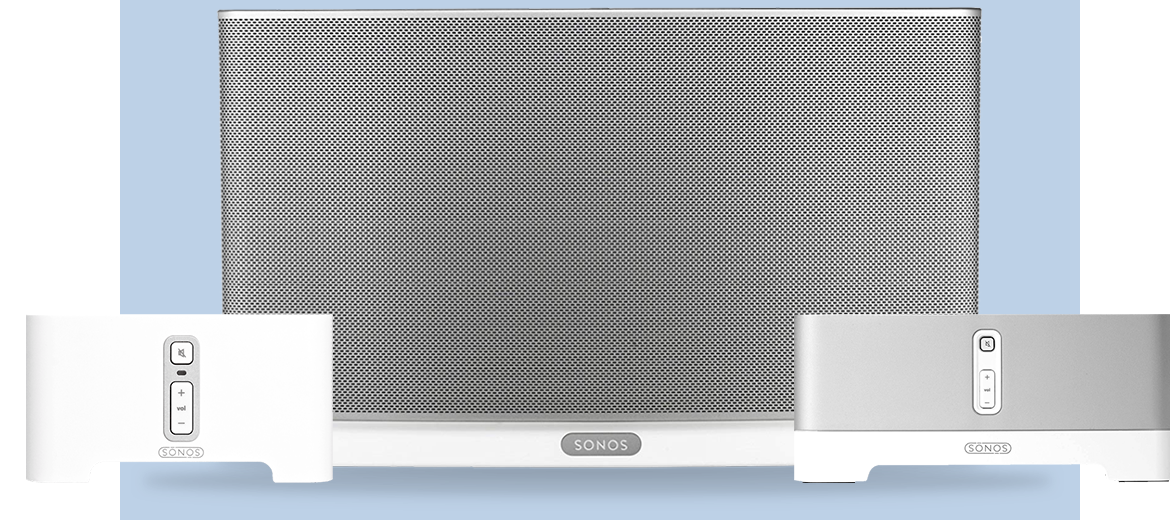
This coming May, these legacy products—our original Zone Players, Connect, and Connect:Amp (launched in 2006; includes versions sold until 2015), first-generation Play:5 (launched 2009), CR200 (launched 2009), and Bridge (launched 2007)—will no longer receive software updates or new features. 

 Today the Sonos experience relies on an interconnected ecosystem, giving you access to more than 100 streaming services, voice assistants, and control options like Apple AirPlay 2. Without new software updates, access to services and overall functionality of your sound system will eventually be disrupted, particularly as partners evolve their technology. 

To help you through this transition, we’re providing two options:

Option 1: Continue using these legacy products, recognizing that your system will no longer receive software updates and new features.  

Option 2: Trade up to a new Sonos product with a 30% credit for each legacy product you replace.

If you’re not sure if your products are affected, you can check in the System tab in your sonos.com-account

If you choose to participate in the trade up program, your legacy products will be put in Recycle Mode, a state that deletes personally identifiable information and prepares these products for e-recycling. Recycle Mode also protects unsuspecting people from buying legacy products that are approaching the end of their useful life and won’t provide the Sonos experience customers expect today. Recycle Mode will only apply to the legacy products listed above.


We ask that you take your legacy products to a nearby certified e-recycling facility. This is the most environmentally friendly way to recycle. That said, if there isn’t a facility in your area, we are happy to pay for you to ship your products back to Sonos for responsible recycling.    


Ideally all our products would last forever, but for now we’re limited by the existing technology. Our responsibility here is threefold: build products that last a long time; continually look for ways to make our products more environmentally friendly through materials, packaging, and our supply chain and take responsibility for helping you through the transition once products near the end of their useful life.  


We’ve always believed in freedom of choice, whether that means choosing a certain streaming service or way to control your listening experience. We hope the choices provided here—continuing to use these products without new software updates or trading up to our modern products—enable you to make the choice that’s right for you. 


We are honored to have a place in your home and want to make sure that we help continue to bring the best experience we can, even when products reach the end of their useful life. 


More information.


Please let us know if you have any questions.

    This topic has been closed for further comments. You can use the search bar to find a similar topic, or create a new one by clicking Create Topic at the top of the page.

    1377 replies

    Lyricist I
    January 22, 2020

    This is sad on so many fronts. I was concerned that the trade up programme was an attempt to poison the 2nd hand market. After all it was only a matter of time before bricked products were being sold.

    Now the fact that all my ‘Modern’ products will stop receiving updates unless I remove my legacy products, makes me feel like the sword of damocles hangs over my investment. The day the Play:1’s are retired will wipe out a lot of equipment.

    The fact is Sonos have a working mesh system now that by and large is very good. All the old equipment supports it. Are they really trying to say that they are going to make changes to thier own system that renders it incompatible with the earlier versions?...there is absolutely no reason for this unless the modern equipment is so close to the edge that they cannot accodate the code to support both the legacy sonosnet and whatever fantastic unrequested features they are planning. Simply put there is no need to stop upgrades to ‘Modern’ devices simply because a legacy device exists.

    If and it is a big if, there is a technical reason why the current generation will not be able to stay compatible with the classic sonosnet and the ‘new’ future then the solution is simple. Introduce a SonosHub. SonosHub can then register any legacy products, talk to them using the existing protocols and translate between the classic sonosnet and whatever it evolves into.

    Make it cheap enough and I figure many of us would accept that the SonosHub will require periodic upgrades. So as long as you have a SonosHub that is no older than say 5 years it will keep all your existing Sonos gear alive without freezing the support of ‘modern’ equipment. An income stream, and customers that are not worried about the next wave of disconinued products.

    Alternatively let the community do the heavy lifting. Give us the ability to develop our own software and upload it to our devices and we will fix this problem of legacy support in no time. 

    I think Sonos is missing the major hit on reputation that this represents. Their products are not cheap, but have had a reputation of lasting a long while. Today that is evaporating. 

    Lyricist I
    January 22, 2020

    I don't understand the decision to obsolete such recent products, much less why Sonos needs to constantly upgrade the software, since I don't really see any new features appearing and the current  functionality is pretty solid.

    If Sonos sticks to this decision, I might as well ditch all my Sonos equipment...replacing all components every 4 or 5 years doesn't justify sticking with this system.  

    Fortunately Airplay 2 is opening up the game for other players with deeper pockets, so alternatives are starting to appear.  Losing customer loyalty in what will be a crowded market may be the kiss of death for Sonos in the long term.


    Lyricist I
    January 22, 2020

    I bought all my sonos equipment end of 2015 and am shocked to see the announcement that software upgrade support is ending so soon.  I suspect this is more about Sonos financial performance and need to push the new products vs. the 2015 technology not supporting today’s needs.  Definitely not hard to write software that works across hardware with different capability levels and feature sets.

    I’m going to post a review on Amazon to warn folks not to purchase the Connect and Connect:Amp products that I currently have with a link to the announcement since these are still for sale with no warnings about impending loss of software upgrade support.

    Lyricist III
    January 22, 2020

    Sonos owners are rightfully pissed right now (including myself), but trashing a company that’s doing such a remarkable job at ruining its own business model is probably a waste of time.

    I would like to know about a good alternative to Sonos? My simple request is to play a CD collection from a NAS, stream radio stations from the web, perform multi-room synchronized playback and a control app for PC/Android.

    Bluesound but are a little $$$


    Thanks bonervz! The DAC in the Node2i is supposed to be WAY better than anything Sonos is providing, so yes, Bluesound may be the answer. The big Q is of course--will NAD/Bluesound be there for me in 5 years? What about 10 years? Insight wanted.

    Stanley_4
    Grand Maestro
    January 22, 2020

    Another important Bluesound question is about any Sonos patent infringement, that can put them in a world of hurt.

    Lyricist I
    January 22, 2020

    Can someone point me to where Sonos made me aware when I purchased their equipment that they only guarantee software support for 5 years and that they would at some render the equipment useless by refusing to support that equipment?  

    My lawyer has asked me to provide them with a copy of the sonos terms and conditions that sets this out.

    Lyricist I
    January 22, 2020

    Fool me once, shame on you; fool me twice, shame on me.

    I will not support a company that will not stand behind their products. I too am out.

    Lyricist I
    January 22, 2020

    Sonos, I really had a WTF moment today. You told me that my March 2015 Play 5 was considered a legacy device that would no longer be supported from May onwards. Hmm…..How to put it?

    I am not angry; it’s worse, I am disappointed. Of myself. For having defended Sonos against criticism and skepticism by friends and family.

    Sonos is overpriced for the sound it delivers, they said.
    Sonos’ proprietary architecture will lock you in, they said.
    You will invest in more and more speakers over the years, but Sonos will always keep the kill-switch, they said.

    Worry not, was my response.
    It’s a great product; a great experience, I said.
    They won’t let the customers down with product support, I said. Why so sure, they asked. To which I answered: They won’t because they cannot afford it. Because Sonos are aware of one critical fact: a vendor-lock-in business model (such as theirs) is doomed to fail if it does not come with premium service and long-lasting support.

    I should have known better.

    And then the way that decision (to abandon “legacy” devices) was communicated. It did not sound like there was a customers’ advocate in the room when that decision made. Sure, taking pressure off the dev department and increasing the chances of selling a lot of additional units sounds like a win-win. Sounds like it, until negative-network effect kicks in. Many of the customers who are affected the most are (read: “were in the past”) Sonos’ strongest promoters.

    - “Let’s get a Sonos system, it looks really cool.”
    - “Yeah, I know, but you know, my uncle Tommy had this system with 18 speakers. He spent thousands on it you know. And then Sonos dropped support for 11 out of 18!”
    - “Shit!! Ok, no, I don’t want to end like that!”

    So! Ok! I’ll admit that technology is changing and I personally know the challenge of supporting and maintaining legacy systems. But somehow… I don’t believe you that there was a technical problem at the heart of the decision. “Since launching our first products, technology has advanced at an exponential rate”. Come on, give me a break. I have wanted streaming audio across rooms five years ago and I want streaming audio across rooms today. So, I wonder what has changed at an exponential rate here? Old processor cannot handle Alexa? Great, that’s a plus. Processor cannot handle AirPlay. Ok, so I’ll accept that missing feature, as I have done in the past with Play5. That’s what I would expect. But why throw all modern devices in the same system under the bus as well? What has changed now compared to missing AirPlay support? Nothing. It is a deliberate decision by Sonos to make their lives easier by stopping development support for older hardware, like mine from 2015.
     

    Or is there a real technical reason? Then please give us some details, so I can judge on my own whether Sonos deserves my money in the future. But don’t treat us like idiots… 
    Or are you saying that 5 years ago you sold me some completely outdated technology as something state of the art?

    Contributor I
    January 22, 2020

    nicely summarized and valid points.  let see if the company clues in and acts/responds appropriately !

    Lyricist I
    January 22, 2020

    Well, I was in still in the process of building out my system with a few rooms to go.  I will be selling my speakers and moving on to a new system.  I don’t do business with people who are so brazenly and unabashedly dishonest.  This is pretty high up on the Mount Rushmore of corporate greed for a company that previously had a strong brand.  It is no coincidence this is occurring as your sales are decelerating after recently going public last year.  Very disappointed.  It is a good lesson to be wary of connected devices going forward.  The ability to reach into my home and destroy property should not be your right.  If a burglar broke into my home and did so, he would go to jail.