
Ryan S
Retired Sonos Staff
January 21, 2020

End of Software Updates for Legacy Products
Related content:Software
End of Software Updates for Legacy Products

Please note that we’ve created a new thread with some clarifications to questions that have come up several times in this thread. Please see here to continue the discussion if you still have any questions. The information contained in this thread is outdated and may no longer be accurate.


We have some important news regarding our oldest Sonos devices shared on the Sonos Blog today. The text of that blog post is being included here for your convenience:


Starting in May 2020, some of our oldest products will no longer receive software updates or new features. We want to explain why and your options. 

When we first set out almost 20 years ago to invent the technology to easily listen to any song in any room, most of the ways we listen to music today did not exist. In fact, the first Sonos products were introduced before the first iPhone was announced and when Myspace still ruled social media. 


In order to invent multi-room music and smart speakers, we combined the worlds of high-fidelity audio and computing. Every Sonos product has a microprocessor, flash memory, and other hardware components typically found in computers and smartphones.  


Since launching our first products, technology has advanced at an exponential rate; from streaming services and voice assistants to wireless networking and Bluetooth capabilities.  Through all of this transformation, we have continued delivering new features via software updates. We’re extremely proud of the fact that we build products that last a long time, and that listeners continue to enjoy them. In fact, 92% of the products we’ve ever shipped are still in use today. That is unheard of in the world of consumer electronics. However, we’ve now come to a point where some of the oldest products have been stretched to their technical limits in terms of memory and processing power.  

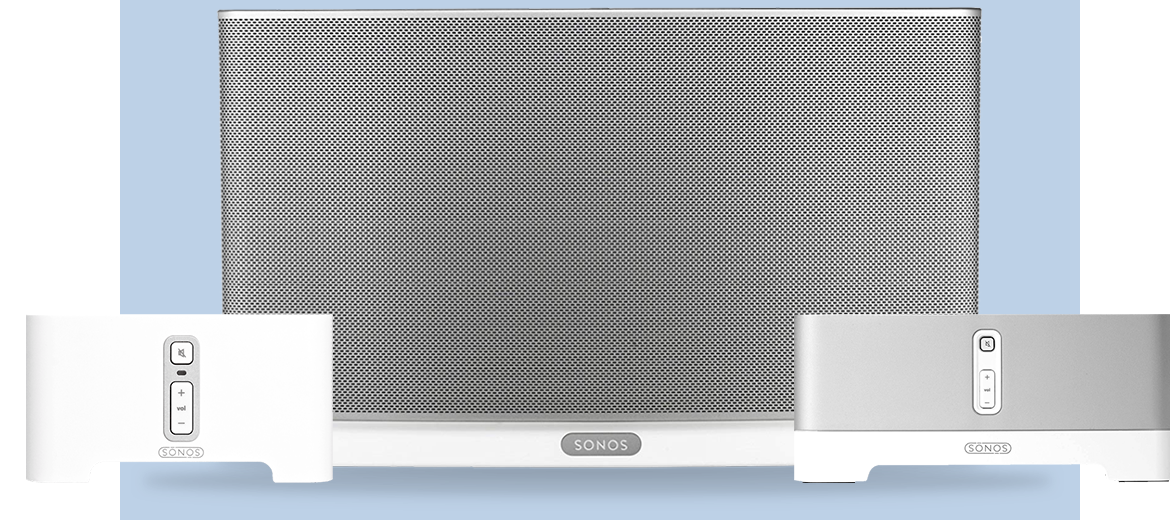
This coming May, these legacy products—our original Zone Players, Connect, and Connect:Amp (launched in 2006; includes versions sold until 2015), first-generation Play:5 (launched 2009), CR200 (launched 2009), and Bridge (launched 2007)—will no longer receive software updates or new features. 

 Today the Sonos experience relies on an interconnected ecosystem, giving you access to more than 100 streaming services, voice assistants, and control options like Apple AirPlay 2. Without new software updates, access to services and overall functionality of your sound system will eventually be disrupted, particularly as partners evolve their technology. 

To help you through this transition, we’re providing two options:

Option 1: Continue using these legacy products, recognizing that your system will no longer receive software updates and new features.  

Option 2: Trade up to a new Sonos product with a 30% credit for each legacy product you replace.

If you’re not sure if your products are affected, you can check in the System tab in your sonos.com-account

If you choose to participate in the trade up program, your legacy products will be put in Recycle Mode, a state that deletes personally identifiable information and prepares these products for e-recycling. Recycle Mode also protects unsuspecting people from buying legacy products that are approaching the end of their useful life and won’t provide the Sonos experience customers expect today. Recycle Mode will only apply to the legacy products listed above.


We ask that you take your legacy products to a nearby certified e-recycling facility. This is the most environmentally friendly way to recycle. That said, if there isn’t a facility in your area, we are happy to pay for you to ship your products back to Sonos for responsible recycling.    


Ideally all our products would last forever, but for now we’re limited by the existing technology. Our responsibility here is threefold: build products that last a long time; continually look for ways to make our products more environmentally friendly through materials, packaging, and our supply chain and take responsibility for helping you through the transition once products near the end of their useful life.  


We’ve always believed in freedom of choice, whether that means choosing a certain streaming service or way to control your listening experience. We hope the choices provided here—continuing to use these products without new software updates or trading up to our modern products—enable you to make the choice that’s right for you. 


We are honored to have a place in your home and want to make sure that we help continue to bring the best experience we can, even when products reach the end of their useful life. 


More information.


Please let us know if you have any questions.

    This topic has been closed for further comments. You can use the search bar to find a similar topic, or create a new one by clicking Create Topic at the top of the page.

    1377 replies

    Lyricist III
    January 21, 2020

    I'm $3000 in for Sonos "legacy" products.  If there's no course correction for all of us who supported and promoted your company, I hope you go bankrupt. 

    Lyricist I
    January 21, 2020

    In short, I’m fine with a frozen system. I just don’t want a bricked system. 

    And when, for example Spotify (replace with online music system you use) change their system that requires SONOS to update their software to keep things working….you’re stuffed.

    Lyricist I
    January 21, 2020

    I just purchased a pair of play 1 speakers from Costco as a kit in dec 2019. Now I see that my play 5 gen 1’s are being dropped from the system. How long before these play 1 speakers are dropped? Are these new play 1’s more advanced than the play 1’s that I bought 8 years ago? And what about my play 3’s, how long will those be supported? And lastly, my whole system is initiated through a bridge connected to a router far away from my other components. Once the bridge and plays 5’s are removed, how do I connect my newer and still functioned speakers to my router? 

    Lyricist III
    January 21, 2020

    I think this is outrageous.

    I am an early adopter of your product and company - have seen it grow from a few home grown distributors to being in John Lewis/Dixons etc. I spent a lot of money on products and systems, have harped on for years to anyone who would listen to how good Sonos is and they duly purchased. Now, you are peanalising those who supported you in the early years. Thats truly disgraceful. There was no mention of you not supporting products when we purchased them. Shame on you Sonos. 

    Totally agree... Just because my car hasn't got all of today's advanced technology means i have to dump it..  

    Lyricist I
    January 21, 2020

    Is Sonos willing to tell me when they are going to obsolete my Play 3’s and Play 1’s? This is B.S. I championed this company to everyone who would listen but those days are over. I’m beyond pissed. After reading some of the posts, I have no confidence that Sonos will leave our legacy system alone if that’s what we choose to stay with. I’m sure eventually it won’t work at all and then what?

    Lyricist I
    January 21, 2020

    This is from an article today: “Sonos told CNBC in May it will launch a way for customers to segment the older products into a separate speaker group, which won’t receive updates, while another group of newer products will continue to get new software.”

    If this is true, it will soften the blow for someone like me who owns just one gen 1Play:5, but it’s still disappointing. What will happen when my Play:3’s and 1’s eventually reach their end of life (from a software upgrade point of view—my Play:5 sounds just as good today as it did the day I inboxed it)?  Anyway, hoping Sonos can find a way to breathe more life into older hardware. 

    Ryan S
    Ryan SAuthor
    Retired Sonos Staff
    January 21, 2020

    I think a major problem is that SONOS needs to better explain the specifics of the impact, the reasons for the impact on legacy systems, and the options going forward from here.

    (1) What I am hearing is that they need to update the SONOS control app on the smart phone. And that changes to the app will require some matching changes to the software on the SONOS devices. And that they won’t make those needed matching changes to the legacy devices. (the functional impact is discussed later)
    Is that a correct summary?
       (a) It is not clear if the changes are not technically possible (lack of memory?) or if SONOS just don’t want to make that investment. It would be good to hear an answer to that.
       (b) why is it not possible for the app to be programmed with a compatibility mode to work with legacy devices just as it does prior to the May 2020 cutoff?

    (2) If I update a control app after May2020, what exactly is the impact on that app working with the legacy devices? Is there some guide as to what functionality might be lost? For example, perhaps only certain new streaming services may not be available, though streaming from my NAS based music collection would be OK.
    Or it may be that even basic communication between unmatched app and devices would be lost (turning the legacy devices into expensive bricks)?

    (3) If we do not update our SONOS smartphone/tablet control app after the May2020 cutoff, then the app will continue to work with our devices indefinitely after that point, though any newly discovered bugs will not be fixed. This can be accomplished by turning off the “Update Automatically” setting and not manually approving any app updates.
    Is that a correct summary?

    (4) The catch is that without new software updates, our frozen control app would no longer be able to support the newer devices, even with old functionality? SONOS statements imply that there is likely more lost than just new functionality (which many of us do not care about), but could impact current functionality.
    Is that correct?

    Would the frozen legacy control app be able to work with the newer “modern” SONOS devices, limited to old functionality? Would it matter whether the “modern” devices have newer software updates? It would be good to have a clear answer on that.

    (5) Further, there is a possibility that SONOS will provide for download of the pre-May2020 control application for use on any new smart device, should I change smart phone or tablet in the future.(or need to delete/reload in a recovery situation).
    Is that correct, and when would we see that as an available download?

    (6) Is it possible to use two different smart devices, one with the frozen legacy app and one with the current supported app. In that case, I should be able to control and update “modern” SONOS devices from one while using the legacy app to control, at least, the legacy devices and perhaps even all my SONOS devices (with old function scope)?

    (7) SONOS is saying all of this is driven by the major music streaming servers changing their interfaces. It is not clear if they are talking about control interfaces or about streaming protocols.
    If the impact of the streaming servers changes is a control interface used only by the SONOS control app, than SONOS should be able to isolate that impact to the control app and still maintain backwards compatibility with the SONOS devices. Correct? Or does the SONOS device need to work with that same changed streaming service control interface?


    If the impact is directly to the software in the SONOS network which is doing the streaming, then only that streaming device needs to be modern. The streaming SONOS device should be able to forward that music content to the other SONOS players/speakers using the old protocols. All of my devices have te ability to stream from the server, but I gather for any particular music stream, only one handles that streaming and passes the content to the rest (in a synchronized fashion).


    This is an important point since, if true, you would only need to ensure that there is one “modern” SONOS device, in the network, for each different streaming source, in order to handle any streaming interface issues. I only use one source at a time, so I would only need one “modern” device. (I am making some educated guesses about the overall design of the SONOS network).
    Is there validity to what I am saying?


    **************************************
       The customers just need to better understanding of the situation and what alternate paths we have going forward. 
       Doing so can be a big win for both SONOS and their customers
    **************************************


    @Michael Arones, thanks for taking the time to write up such detailed questions. Several of these are questions that will be answered later this year when we have more to share. For people who keep their legacy devices and have a fully legacy system, or maybe mixed with modern, we don’t expect any immediate impact from ending the software updates. These systems will continue to work as they do today, or in May, but will not receive future updates. As mentioned before, changes that are made to technology in the future, particularly by music service and voice partners, can cause access to those services or features to be disrupted. This would be mostly in connection protocol on the back end, not just visual changes in their apps.


    Mark good posts by pressing the like button, and select the best answer on questions you've asked to help others find solutions.
    Contributor I
    January 21, 2020

    Sonos used to be known for its software expertise, and this problem could be solved by developing software that could identify each specific piece of Sonos equipment in a home system and then apply a “function profile” to each unit based on the unit’s hardware and memory capacity. As new services or features are developed by Sonos, each user could specify how “modern” they want their system to run. New features could be limited to the hardware that is capable of handling them while the entire system could continue to run at a “basic” level as it does currently. (This would be much like running in “compatibility mode” for word processing software that must work across several computer systems.)


    Although development of this type of software might be challenging, I am certain it would be less costly to the company than the loss of current and future customers that will follow if Sonos’ current plans are implemented. 


    Sonos is able to tell me which Sonos equipment in my system will not be updated after May, so it should be possible to select the equipment that needs to run different software if the user wants to run the system in compatibility mode. The solution to this problem is not in sales/marketing, it’s in software development. So it’s time for Sonos to get to work on a real solution that keeps its customer base happy and keeps the company alive. 

    Enthusiast II
    January 21, 2020

    With the prices you charge nobody expects the product to be obsolete after five years. With cheap junk, yes, but you charge Mercedes Benz prices. Nobody expects to have to junk their Mercedes after five years. It may not be brand new after five years, but still a solid workhorse. This is outrageous. 

    Lyricist I
    January 21, 2020

    As a long time supporter and advocate of Sonos, I'm extremely frustrated, angry, and overall disappointed. 


    With the recent announcement I understand that changes to my system won’t be immediate, but to continue usage of my multiple devices in multiple zones I'll be requires to spend upwards of $500+ dollars to just use the products I spent a shit load of money on the first go around? Come on! 


    Your products are not cheap by any means, and asking us to replace perfectly fine devices with new ones at virtually the same amount is a slap in the face to your loyal customer. 30% off saves us virtually nothing and Sonos generates new revenue while the customer is held holding the responsibility? Not to mention the sheer amount of waste all of these old products are going to create when everyone dumps these into their trash cans vs. a legit recycling program where Sonos does something with the hardware that’s going to become obsolete. 

    What this say is more of my products wont work at some mysterious time and I’ll be left holding the bag again.

    A responsible company would have thought through this before blasting their customers who from your

    forums seems to be fiercely loyal.