
Ryan S
Retired Sonos Staff
January 21, 2020

End of Software Updates for Legacy Products
Related content:Software
End of Software Updates for Legacy Products

Please note that we’ve created a new thread with some clarifications to questions that have come up several times in this thread. Please see here to continue the discussion if you still have any questions. The information contained in this thread is outdated and may no longer be accurate.


We have some important news regarding our oldest Sonos devices shared on the Sonos Blog today. The text of that blog post is being included here for your convenience:


Starting in May 2020, some of our oldest products will no longer receive software updates or new features. We want to explain why and your options. 

When we first set out almost 20 years ago to invent the technology to easily listen to any song in any room, most of the ways we listen to music today did not exist. In fact, the first Sonos products were introduced before the first iPhone was announced and when Myspace still ruled social media. 


In order to invent multi-room music and smart speakers, we combined the worlds of high-fidelity audio and computing. Every Sonos product has a microprocessor, flash memory, and other hardware components typically found in computers and smartphones.  


Since launching our first products, technology has advanced at an exponential rate; from streaming services and voice assistants to wireless networking and Bluetooth capabilities.  Through all of this transformation, we have continued delivering new features via software updates. We’re extremely proud of the fact that we build products that last a long time, and that listeners continue to enjoy them. In fact, 92% of the products we’ve ever shipped are still in use today. That is unheard of in the world of consumer electronics. However, we’ve now come to a point where some of the oldest products have been stretched to their technical limits in terms of memory and processing power.  

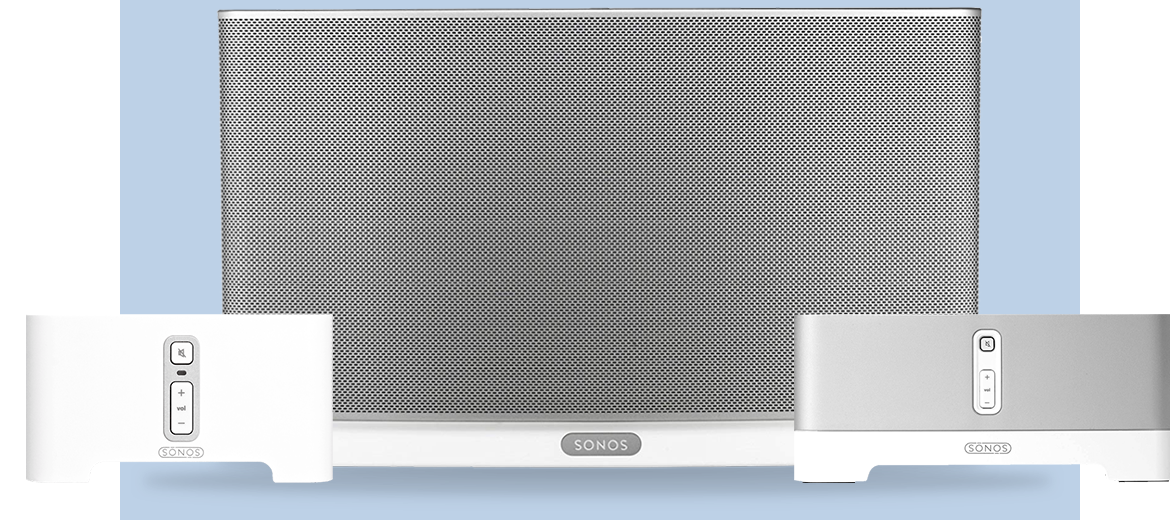
This coming May, these legacy products—our original Zone Players, Connect, and Connect:Amp (launched in 2006; includes versions sold until 2015), first-generation Play:5 (launched 2009), CR200 (launched 2009), and Bridge (launched 2007)—will no longer receive software updates or new features. 

 Today the Sonos experience relies on an interconnected ecosystem, giving you access to more than 100 streaming services, voice assistants, and control options like Apple AirPlay 2. Without new software updates, access to services and overall functionality of your sound system will eventually be disrupted, particularly as partners evolve their technology. 

To help you through this transition, we’re providing two options:

Option 1: Continue using these legacy products, recognizing that your system will no longer receive software updates and new features.  

Option 2: Trade up to a new Sonos product with a 30% credit for each legacy product you replace.

If you’re not sure if your products are affected, you can check in the System tab in your sonos.com-account

If you choose to participate in the trade up program, your legacy products will be put in Recycle Mode, a state that deletes personally identifiable information and prepares these products for e-recycling. Recycle Mode also protects unsuspecting people from buying legacy products that are approaching the end of their useful life and won’t provide the Sonos experience customers expect today. Recycle Mode will only apply to the legacy products listed above.


We ask that you take your legacy products to a nearby certified e-recycling facility. This is the most environmentally friendly way to recycle. That said, if there isn’t a facility in your area, we are happy to pay for you to ship your products back to Sonos for responsible recycling.    


Ideally all our products would last forever, but for now we’re limited by the existing technology. Our responsibility here is threefold: build products that last a long time; continually look for ways to make our products more environmentally friendly through materials, packaging, and our supply chain and take responsibility for helping you through the transition once products near the end of their useful life.  


We’ve always believed in freedom of choice, whether that means choosing a certain streaming service or way to control your listening experience. We hope the choices provided here—continuing to use these products without new software updates or trading up to our modern products—enable you to make the choice that’s right for you. 


We are honored to have a place in your home and want to make sure that we help continue to bring the best experience we can, even when products reach the end of their useful life. 


More information.


Please let us know if you have any questions.

    This topic has been closed for further comments. You can use the search bar to find a similar topic, or create a new one by clicking Create Topic at the top of the page.

    1377 replies

    Enthusiast II
    January 21, 2020

    Does anyone know why some Connect:Amps are legacy and some are not?  Is there a version 2.0 of these?


    There was no formal designation, but it seems later models were equipped with more memory and processor power.  

    Thank you

    Translate
    Lyricist I
    January 21, 2020

    One thing is to announce discontinued support for existing products, another is to inform customers on the future roadmap and support when you buy the product.
     

    Sonos is a high priced product and seldom provide discounts so I recently bought two Play 1:s on discount and was pleased. Little did I know that a new version was silently launched. 
     

    So what kind of support can I expect on my “old” Play 1:s compared to the new version Play 1:s which was launched the month after? The 10% discount I reveives may prove to be costing me more in the long run.


    Sonos - I am  disappointed and you lost my trust. I have been a keen promoter of your system, now I will advise people to rethink and look for options…


    My next system will be Bluetooth based or similar, clearly separating audio hardware and media software!

    Translate
    Lyricist I
    January 21, 2020

    This news effectively eliminated me investing any further money in Sonos. This is an insult to customers and all aspects of the term loyalty. I’m not really surprised by this though, seeing how contemporary people invest in addictions to technology with the promise of “look what you can do”, “see how this improves your life” “now it’s even better”, “get the updates” “the latest and greatest” etc. etc. How much time do you invest in fooling around with your “tech”, needing to look at it while you’re driving, walking, sitting around? How much time do you invest in updating your “apps” and adjusting your systems in order to do simple things, like listening to music without doing anything else.

    but we’ll give you a 30% discount to buy more of this. really? 30% is an insult, that I won’t accept.

    Translate
    Lyricist I
    January 21, 2020

    Thanks God I sold my SONOS stocks at a profit before receiving this email from them. That stock is going down to minus ZERO!

    Translate
    Lyricist III
    January 21, 2020

    At the very least sonos should postpone this decision… 


    Then work on creating a legacy bridge product that handles the new cpu/memory requirements for the software update. Sell this bridge and it will handle the processing power for any legacy items in the consumers stack and turn the legacy hardware into dumb slaves that just listen to the new bridge product your selling. 


    Then once this product is availble you can require that customers buy this bridge so they continue to receive software updates. That way Sonos you aren’t responsible for a great deal of e-waste pollution because your customers can purchase a device that will keep their legacy equipment updated & working.

    Translate
    January 21, 2020

    This is really sad news for all Sonos customers.


    Most of us will now think twice before buying anything again, as we have learned that at any time, sooner or later, all our investments into Sonos system will vanish.


    Why couldn't you offer a kind of better, cost-effective solution to your customers than throwing away 70% of money spent on their systems? 

    Too bad!

    I doubt I will be suggesting Sonos to my friends any more! 

    Not being able to support two branches of firmware and compatibility between them is not an excuse!

    Translate
    melvimbe
    January 21, 2020

    The 30% off is a joke to trade up, with Sonos margins so rich they are still making serious profit from distressed clients. 


    Where are you getting Sonos margin percentages from?  Was it posted in the shareholders report?

    Translate
    Danny
    pwt
    Virtuoso
    January 21, 2020

    At the current exchange rate, I’ve spent a total of $7,000 on Sonos equipment. I have a mixture of outdated and non-outdated equipment across two properties. It’s delivered a generally very good experience and I’ve loved using it. I’ve developed my own software solutions around any limitations that are important to me.

    I will not be spending any more on Sonos.

    Fundamentally, this is because Sonos has demonstrated it does not have the software engineering capability to manage a smooth evolution of its product family. Instead, it depends on a clumsy, ‘lock-step’ update approach. Today’s evidence that they cannot evolve beyond this approach makes this a watershed moment. For the future, I will be seeking solutions where I am not dependent on software I cannot control.

    Edit: Another reason for not purchasing additional equipment is the fact that today’s announcement has reduced the probability of Sonos continuing in business.

    Translate
    4 x P:5 | Sub | 4 x P:1 | 3 x Connect | 2 x Boost | Connect:Amp | 2 x One | Amp | Move | Port | Era 300
    Headliner I
    January 21, 2020

    All this said, Sonos app is working on all our old android tablets over time that we were told might have limited functionality and no new features.

    Maybe I missed it in the discussion but does it mean that those boxes “will not play music” or “will not have new whistles and bells”? 

    I’m unclear on that?

    In May, the change will be that legacy players won’t get updates, so no new whistles and bells. However, if at some point in the future after then, a music service like Spotify or Apple Music changes their service connection protocols, there won’t be a software update for legacy devices to fix that connection and the service would stop working.

    Thanks for clarifying Ryan. Whilst a lot of frustration tonight (and in the main fairly so) this does at least explain the music playing reality for the near future.

    So basically we can play music for the foreseeable future until the streaming providers stop supporting?

    Translate
    melvimbe
    January 21, 2020

    Does anyone know why some Connect:Amps are legacy and some are not?  Is there a version 2.0 of these?  Wondering if the Connect Amps that I have that are currently labeled as non-legacy are good for now or if that’s an error. 


    Since Sonos stated there reason had to do with the hardware and thus capabilities of the legacy units, it makes sense that there was a hardware change in the Connect:amp and Connect line of products back around 2015.  

    Translate
    Danny