
Ryan S
Retired Sonos Staff
January 21, 2020

End of Software Updates for Legacy Products
Related content:Software
End of Software Updates for Legacy Products

Please note that we’ve created a new thread with some clarifications to questions that have come up several times in this thread. Please see here to continue the discussion if you still have any questions. The information contained in this thread is outdated and may no longer be accurate.


We have some important news regarding our oldest Sonos devices shared on the Sonos Blog today. The text of that blog post is being included here for your convenience:


Starting in May 2020, some of our oldest products will no longer receive software updates or new features. We want to explain why and your options. 

When we first set out almost 20 years ago to invent the technology to easily listen to any song in any room, most of the ways we listen to music today did not exist. In fact, the first Sonos products were introduced before the first iPhone was announced and when Myspace still ruled social media. 


In order to invent multi-room music and smart speakers, we combined the worlds of high-fidelity audio and computing. Every Sonos product has a microprocessor, flash memory, and other hardware components typically found in computers and smartphones.  


Since launching our first products, technology has advanced at an exponential rate; from streaming services and voice assistants to wireless networking and Bluetooth capabilities.  Through all of this transformation, we have continued delivering new features via software updates. We’re extremely proud of the fact that we build products that last a long time, and that listeners continue to enjoy them. In fact, 92% of the products we’ve ever shipped are still in use today. That is unheard of in the world of consumer electronics. However, we’ve now come to a point where some of the oldest products have been stretched to their technical limits in terms of memory and processing power.  

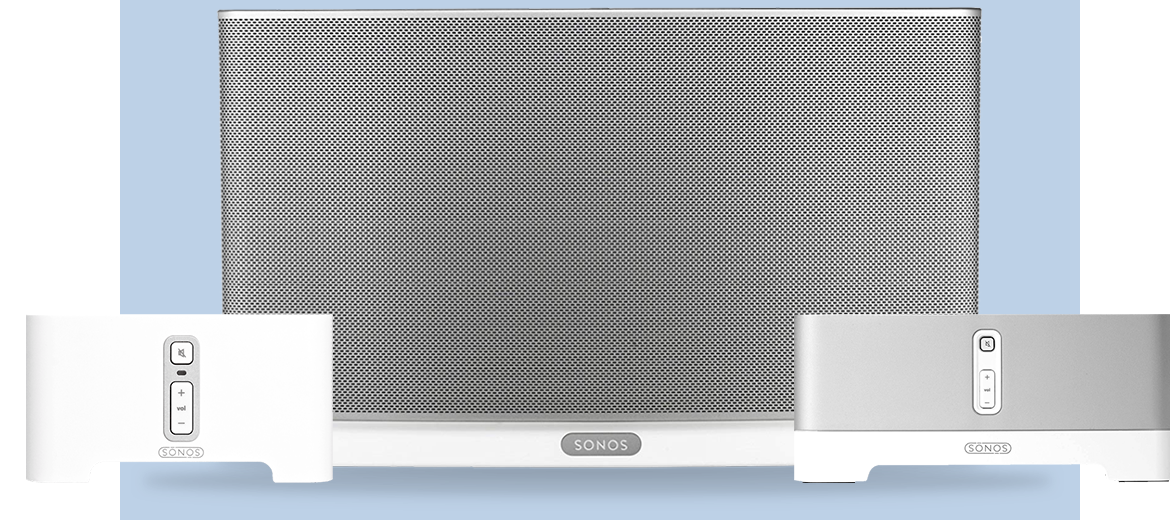
This coming May, these legacy products—our original Zone Players, Connect, and Connect:Amp (launched in 2006; includes versions sold until 2015), first-generation Play:5 (launched 2009), CR200 (launched 2009), and Bridge (launched 2007)—will no longer receive software updates or new features. 

 Today the Sonos experience relies on an interconnected ecosystem, giving you access to more than 100 streaming services, voice assistants, and control options like Apple AirPlay 2. Without new software updates, access to services and overall functionality of your sound system will eventually be disrupted, particularly as partners evolve their technology. 

To help you through this transition, we’re providing two options:

Option 1: Continue using these legacy products, recognizing that your system will no longer receive software updates and new features.  

Option 2: Trade up to a new Sonos product with a 30% credit for each legacy product you replace.

If you’re not sure if your products are affected, you can check in the System tab in your sonos.com-account

If you choose to participate in the trade up program, your legacy products will be put in Recycle Mode, a state that deletes personally identifiable information and prepares these products for e-recycling. Recycle Mode also protects unsuspecting people from buying legacy products that are approaching the end of their useful life and won’t provide the Sonos experience customers expect today. Recycle Mode will only apply to the legacy products listed above.


We ask that you take your legacy products to a nearby certified e-recycling facility. This is the most environmentally friendly way to recycle. That said, if there isn’t a facility in your area, we are happy to pay for you to ship your products back to Sonos for responsible recycling.    


Ideally all our products would last forever, but for now we’re limited by the existing technology. Our responsibility here is threefold: build products that last a long time; continually look for ways to make our products more environmentally friendly through materials, packaging, and our supply chain and take responsibility for helping you through the transition once products near the end of their useful life.  


We’ve always believed in freedom of choice, whether that means choosing a certain streaming service or way to control your listening experience. We hope the choices provided here—continuing to use these products without new software updates or trading up to our modern products—enable you to make the choice that’s right for you. 


We are honored to have a place in your home and want to make sure that we help continue to bring the best experience we can, even when products reach the end of their useful life. 


More information.


Please let us know if you have any questions.

    This topic has been closed for further comments. You can use the search bar to find a similar topic, or create a new one by clicking Create Topic at the top of the page.

    1377 replies

    Enthusiast I
    January 22, 2020

    Moreover, you will still be supporting the Play3? It’s older than the Play5 Gen 1 you are scrapping. Doesn’t add up.


    Exactly, it’s one of the dead giveaways that the hardware excuse is just a convenient cover for their cash grab.

    I bought my 1st generation Play:5 and 2 x Play:3 on the same day and yet they’re saying only the Play:5 is “obsolete”. The Play:5 was significantly more expensive than the Play:3’s and was sold up until 2015, so why does it contain crappier technology at a higher price point?

    During the rollover period from Play:5 Gen 1 to Play:5 Gen 2 they never told customers “don’t buy a Gen 1, you’ll only get 5 years of support before we brick your unit and ask for you to buy it all over again”.

    I hope they release full technical diagnostics on precisely why these systems are considered “obsolete” and what they’ve done to try to include them. It’s my guess there is nothing but greed preventing them from running older units with limited features, providing a LTS version, or allowing them to run separately or standalone.

    Lyricist III
    January 22, 2020

    Sonos tells me that some of my Connect AMPs are ok and will be supported while some are obsolete after 1 May.  What technically is the difference the look identical from the outside.  

    In the UK Dixons is still selling Connect AMP.  I saw it at Heathrow Terminal 2 today!  Whats going on?


    Enthusiast II
    January 22, 2020

    Sonos tells me that some of my Connect AMPs are ok and will be supported while some are obsolete after 1 May.  What technically is the difference the look identical from the outside.  

    In the UK Dixons is still selling Connect AMP.  I saw it at Heathrow Terminal 2 today!  Whats going on?


    I asked this earlier because I experienced the same thing.  Some connects and connect amps have better processors and more memory -- those sold later in time. 

    Lyricist III
    January 22, 2020

    Its obvious why the keep the Play 3.  They havent upgraded that one yet.  I am sure 1st gen Sonos 1 will go soon as well.  Need to sell more!!


    Lyricist III
    January 22, 2020

    I am sure a technician can upgrade the memory on Connect Amp.  They should offer a trade in and then refurbish them. Or a refurbish opotion.

    Where is SONOS on sustainability????

    Avid Contributor I
    January 22, 2020

    I’ll add the obvious that this is not a fridge that can’t update its screen. This isn’t a generation of iphones that reach their EOL and can’t do new things but that still work. This is an entire ecosystem that is effected.


    Maybe Sonos should tell our Grandmas why their pandora station won’t play in the spring?


    Sonos points out that these products were last produced years ago yet most of the items are still out in the wild. They are still being bought and sold. 
     

    Why is that? Because the system and technology hasn’t changed that much. Unlike the differences in ten years of something like the iPhone, the new Sonos devices aren’t really that different than the old. Sonos never gave us early adopters reason to upgrade. In fact, the app is slower than in years past for the importance functions like turning iff an alarm or turning off a explicit song in a kids room.

    Lyricist III
    January 22, 2020

    This has been driving me crazy all day....I was finally able to find a little hope to calm my initial reaction....please Sonos make good on this......read this article

    https://www.google.com/url?sa=t&source=web&rct=j&url=https://www.engadget.com/amp/2020/01/21/sonos-legacy-products-software-updates-ending/&ved=2ahUKEwj0yO-tzZbnAhVLrJ4KHY-xDlg4ChAWMAd6BAgGEAE&usg=AOvVaw13da3ceexWptRSPKbGUkcT

    Remaining hopefull

    Lyricist I
    January 22, 2020

    Like everyone else--I am furious. I have spent a lot of money on Sonos over the years, and you’ve just told me that my 5 year old Play 5 either needs to be replaced or my entire system will gradually stop working. For a company that’s trying to fight off inexpensive imitator speakers from Big Tech, you are doing a GREAT job of pushing your customers to said inexpensive imitator speakers. 

    January 22, 2020

    Like most here, I’m pissed, but then I haven’t been happy with Sonos for a while. I can’t upgrade to the new operating system on my Mac, because if I do Sonos won’t work. Any songs I have that are .m4a don’t play on my Sonos. I’ve called Tech support on both issues and they tell me “Sonos is working on it.” And now I’m being told that the equipment I have is going to be unsupported and will therefore become obsolete. So I’m done. I have a call in to my local stereo shop to find something to replace what I have and I will never buy Sonos again. Even if they somehow go back on this threat, this shows me what they are capable of. Really is too bad, as I liked their product when I first bought it. I was quite the ambassador for them. Recommended Sonos to anyone who would listen. Not anymore. Goodbye Sonos.

    Avid Contributor I
    January 22, 2020

    Summarizing 3 main points here about the recent Sonos EOL announcement.


    1. End of life dates need to be announced in advance of folks investing in a product. If you buy a chromebook now you know the date it will stop receiving updates and potentially not be compatible with partner software. It’s obviously unethical to tell someone who may just have bought an AMP yesterday that their product may not function correctly and is worth less. We aren’t dealing with an OS here where people are aware that their products come in versions and can break at the software level. It’s egregious enough that legality and class actions are likely in play.
       
    2. The narrative is that people have a choice and we’re hearing things like... “If I choose to trade in” or if “I go with keeping my old system”. This should be rejected. Yes, you have the choice to eat your turd sandwich and buy something new, whatever that may be. Or, you can not accept that a solvent company is making a business decision to bait n switch you. 
    1. Regardless of the worst case scenarios, I think posts like this are  almost unnecessary. Failing to do the minimum to make the basic functions work would be brand suicide. Even a tiny percentage of us who are unable to use our devices would be a turd in the olympic swimming pool. Yes, another reference to the turd this is. Even Microsoft has pushed back their PRE-announced EOL. I’m sure the new SONOS investor group looked at this on paper and it made sense. The software engineers made sense as well. In the real world it will be too expensive. They have to be about to walk this back in the form of clarifying that old devices can not be bricked.


    I have 20 devices + multiple family homes that I set up + investment in specific speakers and construction for said devices. Am I supposed to   suddenly call Sonos come spring with $20,000 for them?