
Disclaimer: What follows is not intended as an inducement for anyone to join/subscribe to a music service. What’s intended is to offer those who might be interested in a cost-effective way to own and store music on a NAS device they would like to keep for prosperity and enjoy via the Sonos Music Library. That said let’s begin:
There is particular music (artist/songs) that I still like to own and store on my NAS vs streaming and/or creating a playlist within the streaming service. Even though I can download streamed music to my device multiple times (as long as I have a subscription to the service) there is IMO a downside:
- If I leave the service and somehow loose the downloaded track(s); or my device is destroyed, I no longer have access to that music.
Purchasing music can be an expensive proposition which is why I choose wisely those tracks I want to own. I have been an AppleMusic fan going back to the days when it was iTunes.
However, Apple in its infinite wisdom has decided either by its own enforcement or that of the artist to add another DRM layer to some music called HLS. HLS is very unfriendly as it relates to “playability” on NAS which will impact the Sonos Music Library. You can read the AI Generated synopsis on HLS below or just skip to the next section:
HLS (HTTP Live Streaming) for music is an industry-standard protocol used to deliver audio over the internet in small, manageable segments rather than as one large file. While originally developed by Apple, it is now a universal standard supported across Android, Windows, and most modern browsers.
In the context of music, HLS serves two primary purposes:
1. High-Quality & Lossless Streaming (Apple Music)
Apple uses HLS specifically to deliver Lossless and Hi-Res Lossless audio.
- Format: When you download lossless music on Apple Music, the files are often delivered in a copy-protected HLS format based on the ALAC (Apple Lossless Audio Codec).
- DRM Protection: Unlike standard iTunes purchases (which are DRM-free 256 Kbps AAC files), music in HLS format is protected by Digital Rights Management (DRM) and requires an active Apple Music subscription to play.
- Device Limitation: Because of this protection, HLS music files are typically only playable on Apple Music-compatible devices and cannot be easily converted or used in third-party media players.
2. Technical Performance
For broadcasters and general music streaming services (like Spotify or online radio), HLS provides several performance advantages:
- Adaptive Bitrate (ABR): The player automatically detects your internet speed and switches between different audio qualities (e.g., from 320 kbps to 128 kbps) in real-time to prevent buffering.
- Stability & Battery Life: By downloading small "segments," mobile devices can power down their Wi-Fi or cellular modems between downloads, which improves battery life and makes the stream more resilient to network dead zones.
- Advanced Features: It supports multiple audio tracks (for different languages), synchronized metadata (like lyrics), and seamless ad insertion.
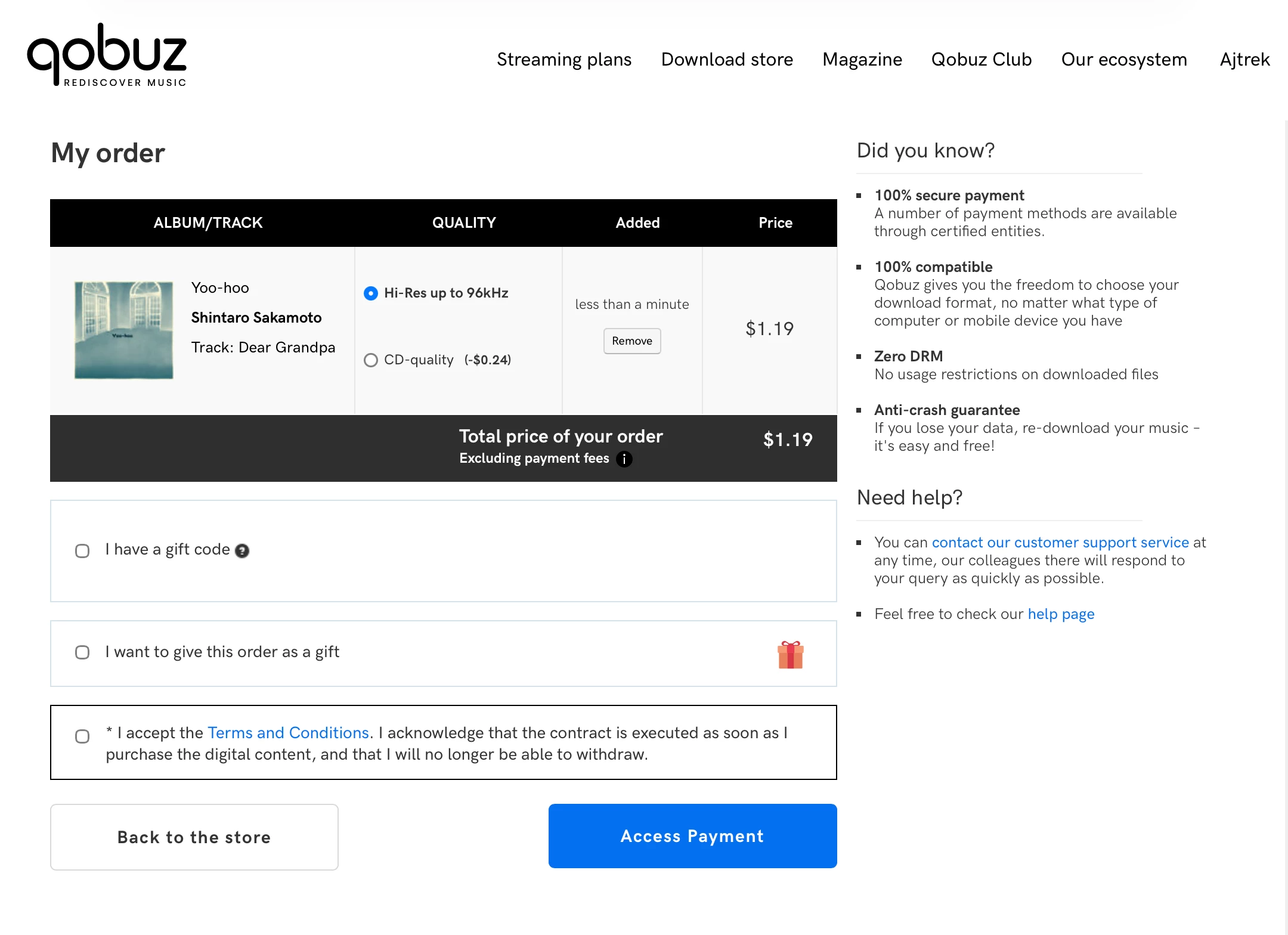
Given that I still want to own music and previously used AppleMusic as the “online” retail purchase source I was forced to seek an alternative. What I discovered was qobuz. Some of you may already be familiar with it. Qobuz allows me to purchase just about any artist; or individual track, IMO at a reasonable cost that is DRM Free.
Below is a screen shot of the purchase format/cost options one might choose. I typically choose Hi-Res.
As I stated in the beginning this post is for informational purposes only. Qobuz is a privately owned company located in France. Enjoy your Sonos and the music!