
Ryan S
Retired Sonos Staff
January 21, 2020

End of Software Updates for Legacy Products
Related content:Software
End of Software Updates for Legacy Products

Please note that we’ve created a new thread with some clarifications to questions that have come up several times in this thread. Please see here to continue the discussion if you still have any questions. The information contained in this thread is outdated and may no longer be accurate.


We have some important news regarding our oldest Sonos devices shared on the Sonos Blog today. The text of that blog post is being included here for your convenience:


Starting in May 2020, some of our oldest products will no longer receive software updates or new features. We want to explain why and your options. 

When we first set out almost 20 years ago to invent the technology to easily listen to any song in any room, most of the ways we listen to music today did not exist. In fact, the first Sonos products were introduced before the first iPhone was announced and when Myspace still ruled social media. 


In order to invent multi-room music and smart speakers, we combined the worlds of high-fidelity audio and computing. Every Sonos product has a microprocessor, flash memory, and other hardware components typically found in computers and smartphones.  


Since launching our first products, technology has advanced at an exponential rate; from streaming services and voice assistants to wireless networking and Bluetooth capabilities.  Through all of this transformation, we have continued delivering new features via software updates. We’re extremely proud of the fact that we build products that last a long time, and that listeners continue to enjoy them. In fact, 92% of the products we’ve ever shipped are still in use today. That is unheard of in the world of consumer electronics. However, we’ve now come to a point where some of the oldest products have been stretched to their technical limits in terms of memory and processing power.  

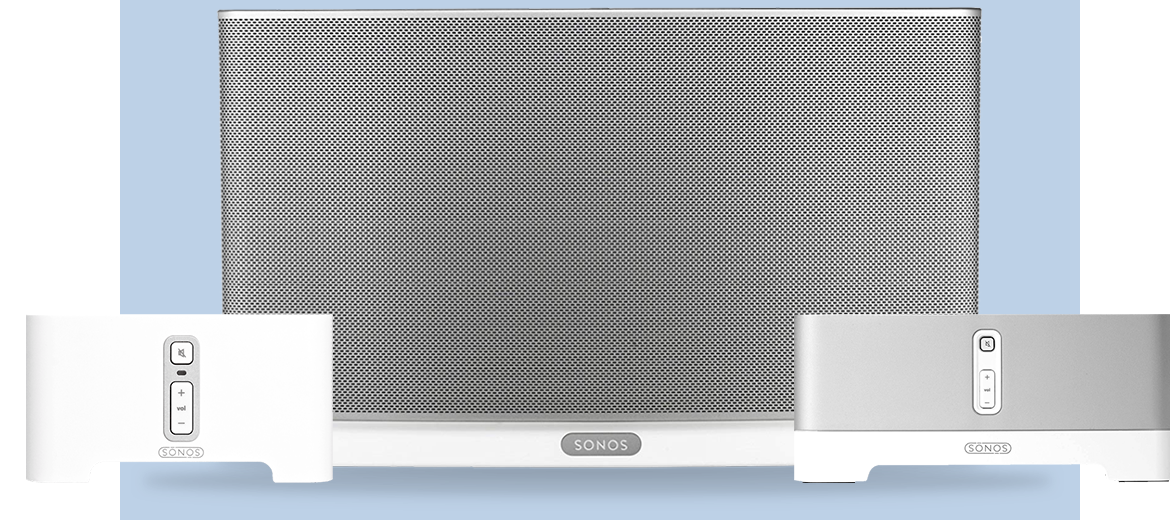
This coming May, these legacy products—our original Zone Players, Connect, and Connect:Amp (launched in 2006; includes versions sold until 2015), first-generation Play:5 (launched 2009), CR200 (launched 2009), and Bridge (launched 2007)—will no longer receive software updates or new features. 

 Today the Sonos experience relies on an interconnected ecosystem, giving you access to more than 100 streaming services, voice assistants, and control options like Apple AirPlay 2. Without new software updates, access to services and overall functionality of your sound system will eventually be disrupted, particularly as partners evolve their technology. 

To help you through this transition, we’re providing two options:

Option 1: Continue using these legacy products, recognizing that your system will no longer receive software updates and new features.  

Option 2: Trade up to a new Sonos product with a 30% credit for each legacy product you replace.

If you’re not sure if your products are affected, you can check in the System tab in your sonos.com-account

If you choose to participate in the trade up program, your legacy products will be put in Recycle Mode, a state that deletes personally identifiable information and prepares these products for e-recycling. Recycle Mode also protects unsuspecting people from buying legacy products that are approaching the end of their useful life and won’t provide the Sonos experience customers expect today. Recycle Mode will only apply to the legacy products listed above.


We ask that you take your legacy products to a nearby certified e-recycling facility. This is the most environmentally friendly way to recycle. That said, if there isn’t a facility in your area, we are happy to pay for you to ship your products back to Sonos for responsible recycling.    


Ideally all our products would last forever, but for now we’re limited by the existing technology. Our responsibility here is threefold: build products that last a long time; continually look for ways to make our products more environmentally friendly through materials, packaging, and our supply chain and take responsibility for helping you through the transition once products near the end of their useful life.  


We’ve always believed in freedom of choice, whether that means choosing a certain streaming service or way to control your listening experience. We hope the choices provided here—continuing to use these products without new software updates or trading up to our modern products—enable you to make the choice that’s right for you. 


We are honored to have a place in your home and want to make sure that we help continue to bring the best experience we can, even when products reach the end of their useful life. 


More information.


Please let us know if you have any questions.

    This topic has been closed for further comments. You can use the search bar to find a similar topic, or create a new one by clicking Create Topic at the top of the page.

    1377 replies

    Lyricist I
    January 22, 2020

    Seriously not impressed. I’ve received your email telling me my perfectly good, non-recyclable, plastic, Play-5 (Gen 1 ) Sonos speaker will no longer be supported. Seriuosly pissed off because being impressed by the quality of the sound from the Play-5, I (now with hindsight, foolishly) went and purchased the Sonos Beam, which will also be hobbled by your intentional obsolescence of my perfectly functional, Play-5.

    I am angry and upset by your intentional attempt at forcing more money out of me by scrapping my existing product - that I own and paid you for! 

    I considered using your ‘recycling’ scheme but doubt whether it doesn’t just end up in a bin if I send it to you to deal with.

    I also do not know whether I want to upgrade knowing that you will no doubt render my Sonos Beam useless in three to four years time.

    You have damaged my loyalty to you and this will be taken into account the next time I am in the market for audio products.

    I am an Electronics Engineer and seriously wonder how often streaming a music file over a local area network changes from one year to the next. All of the user interface is in a mobile phone app or tablet so I do not accept the reasons that you have given as to why my Sonos Play-5 is no useless.

    Thanks for nothing.

    Enthusiast I
    January 22, 2020

    I bought a Play 5 (Gen 1) and Bridge combo when I retired as a very extravagant present for myself. I had a large and growing collection of CDs that I had added to my iTunes library and had been looking for a system to allow me to play my music wirelessly throughout my home. At the same time I bought a Mac Mini to replace my ageing Windows PC and an iPod to use primarily as the Sonos Controller. I am not rich and I made these purchases only after a lot of hesitation and serious soul searching.


    I was absolutely delighted with my then basic Sonos system, declaring it to be one of the best things I had ever bought for myself, and like many others I have promoted Sonos to friends and associates. A couple of years later I added 2 more Play 5s (again Gen 1) and later still 2 Play 1s which then completed my system with a speaker now in each room. By now my music collection had risen to over 50,000 tracks.


    The iPod was the first casualty when an update rendered it obsolete as a Sonos controller. I bought an iPad to replace it - first Sonos disappointment involving further expenditure.


    I use my system to play my own music, set alarms and to listen to Radio using TuneIn and have little interest in music streaming services. If I’m honest I find the Play 1s to be virtually as good as the Play 5s in terms of the sound quality but the best thing about the 5s is the line-in function and headphone socket, features that have never been incorporated into the less expensive speakers which I find very useful.


    A few months ago, without a great deal of warning, Sonos announced that the “play from this iPad” function would no longer work with speakers that do not support Airplay - another Sonos disappointment as I occasionally used that when visiting my daughter to play music on my iPad through her Play 1.


    As recently as a couple of weeks ago, again after a lot of deliberation, I bought a Beam in the hope that it would improve the sound from my Samsung Smart TV. It’s OK but I wouldn’t say it’s brilliant. Of necessity it sits in front of the TV where it blocks the remote receiver on my TV meaning that I have to stand over the TV to use the remote, and Alexa can’t even access my music library - another unexpected Sonos disappointment. It came with a free 6 month Spotify Premium trial subscription which I am familiarising myself with but from experience so far I doubt I’ll continue to subscribe.


    Yesterday’s e mail from Sonos has now basically informed me that the bulk of my system will no longer be supported from May 2020 and that if I continue to use it in combination with my Play 1s and Beam they too will be unable to receive updates meaning that over time the entire system will lose some functionality.


    The offer to get a 30% discount off replacement products is absolutely derisory besides which even if I could afford 3 Play 5s at 70% of list price, the current model doesn’t have the ‘line in’ function that I find so useful. The Play 1s, not currently defined as legacy products, are now discontinued so no doubt before too long another Sonos e mail will announce that they too are about to become obsolete.


    I simply cannot afford to replace my entire Sonos system so my knee-jerk reaction is to list the Beam on Ebay whilst it’s still new enough to achieve a sale price equal to what I paid for it and to then allow my system to run without updates until it fails and, in the meantime research what alternatives are available for someone, like me, who simply wants to listen to my CD collection.


    I will however wait until May to see what the as yet unannounced work-around to run legacy speakers on a separate Sonos system involves.


    My faith in Sonos right now is shattered. Whilst I understand that nothing lasts forever I don’t think it unreasonable to expect very, very expensive equipment, that can still work as it was initially intended to, should no longer be updatable purely because the developers want their customers to alter their listening habits. So Sonos please tell me why I should even consider buying more of your products or recommend them to others.


    Contributor I
    January 22, 2020

    Patrick Spence I spent 6000 e on a sonos system in 2007 ..now u inform us that the system becomes obsolete in May ... I am 63 years this year and I'm still going strong .... I'm glad your not  in charge of  end of life decisions.... or I wouldn't see my 64th .


    This is nothing but blatant corporate greed... I will investigate other systems   despite being a loyal customer and there's no one to fit them anyway .

    Enthusiast I
    January 22, 2020

    I might need to look as some sort of opensource alternative using a Raspberry Pi!!!!


    This might be the way to go, although it looks like it needs a fair amount of work still.


    Anyone looked at this? http://strobe.audio


    pwt
    Virtuoso
    January 22, 2020

    This will be nightmare for me as I have power management on all units and do only activate them when in use! 

    As of now it appears that you will have to leave one legacy unit powered on all the time to prevent the rest of such from being bricked via an update that slips past unwittingly.

    I’ve not seen anything that suggests that units will be ‘bricked’, under any circumstances. What’s your source for this?

    The danger, I believe, is that non-outdated components of a mixed system get inadvertently updated, and will then no longer work as part of the same system with the outdated devices.

    If the current products get unwittingly updated, how will the updated controllers work with the legacy devices that are not updated? How will the latter work at all then?

    At worst, one will need to retain an outdated controller or use a third party mechanism. However, Sonos is hinting that a single controller will be able to operate both legacy and non-legacy systems, arranged as separate systems. (This kind of information is something they should have absolutely nailed down prior to making this announcement.)

    Respectfully, back to my original question: do you have anything to support your assertion that the players themselves are bricked? I don’t think that’s the case.

    4 x P:5 | Sub | 4 x P:1 | 3 x Connect | 2 x Boost | Connect:Amp | 2 x One | Amp | Move | Port | Era 300
    Enthusiast I
    January 22, 2020

    This will be nightmare for me as I have power management on all units and do only activate them when in use! 

    As of now it appears that you will have to leave one legacy unit powered on all the time to prevent the rest of such from being bricked via an update that slips past unwittingly.

    I’ve not seen anything that suggests that units will be ‘bricked’, under any circumstances. What’s your source for this?

    The danger, I believe, is that non-outdated components of a mixed system get inadvertently updated, and will then no longer work as part of the same system with the outdated devices.

    If the current products get unwittingly updated, how will the updated controllers work with the legacy devices that are not updated? How will the latter work at all then?

    At worst, one will need to retain an outdated controller or use a third party mechanism. However, Sonos is hinting that a single controller will be able to operate both legacy and non-legacy systems, arranged as separate systems. (This kind of information is something they should have absolutely nailed down prior to making this announcement.)

    Respectfully, back to my original question: do you have anything to support your assertion that the players themselves are bricked? I don’t think that’s the case.

    The players aren’t going to be bricked straight away. The issue comes if a streaming service makes a breaking change to their streaming service API (e.g. a security change). That then means that the legacy products are no longer able to stream the streaming service. You may still be able to stream other streaming services, but gradually the functionality of the speaker will cease.

    Lyricist II
    January 22, 2020

    Oh deary me.

    Moved into my house in 2015 and was impressed by the Sonos System. Bought a Play 5, then a Play 3, then a Connect, then a Play 1. Was just about to look into a Playbar and and possible Amp for TV.


    Received the email. My Play 5 is no longer being supported from May? Run with it and the rest of my devices are no longer updated or a pathetic 30% discount on new kit? 
     

    Look Sonos, my speaker system plays music and  in 10 years time i want it to just play music. I’m not interested in voice control and other features other than playing music.
     

    I get that you want to provide bells and whistle and new features - which is great, but why can’t you do that on new devices which people can purchase if they wish. To turn off support for products which do a pefrecty good job just because the latest featureset cannot be applied is appalling.

    If i wanted new features, then i may purchase new hardware if they were of interest - but currently i don’t and i won’t. My current products work fine as they are, and do the job i paid for them.

    Please please consider keeping these systems operational alongside other “modern” sonos devices just for playing music and nothing else.


    After the 65,000 limit was encountered - i had to setup a Plex server in the house to stream my music from. That’s all i want to do with my Sonos speakers. I don’t even host or catalogue my music on the Sonos anymore due to the limit.
     

    Once the Play 5 is unsupported, i’m guessing the rest of my kit will quickly follow behind - seeing it was all purchased around the same time.
     

    So, on the basis that you have the ability to just switch off updates to your (expensive) hardware and the unknown of whether they will still be able to stream music next year - I cannot and will not invest any more money into my Sonos infrastructure until this is clarified.


    This a bad bad move for Sonos. Please reconsider - as i will now be looking at other possibilities for multi-room music if i have to start again replacing “legacy” hardware not even 5 years old in my house yet.


    One last thing. You boast about your fantastic substainabilty:
    https://blog.sonos.com/en-gb/sonos-sustainability/


    Yet if i “tradeup”, your brick my device into nothing more than an expensive doorstop that we have to dispose of. That’s nice.


    So Sonos. Please please think carefully about your strategy moving forward - before you anger everyone.


    Otherwise i like any will just spend my trade up money elsewhere. I’m not buying into time limited hardware - where the manufacturer decides how long of a life time i get out the product i pay for.


    Lyricist I
    January 22, 2020

    What an absolute farce.


    Sonos, let it be known that you have absolutely killed your future. You have destroyed the one thing that allowed you to sell these overpriced paperweights for so long, loyalty.


    I hope people dump their junk at your door for years to come.

    pwt
    Virtuoso
    January 22, 2020

    The players aren’t going to be bricked straight away. The issue comes if a streaming service makes a breaking change to their streaming service API. That then means that the legacy products are no longer able to stream the streaming service. You may still be able to stream other streaming services, but gradually the functionality of the speaker will cease.

    I know that. I’m wondering why @Kumar thinks otherwise.

    4 x P:5 | Sub | 4 x P:1 | 3 x Connect | 2 x Boost | Connect:Amp | 2 x One | Amp | Move | Port | Era 300
    Lyricist I
    January 22, 2020

    As of right now, my 2015 Connect seems to have scraped through the cull. Phew.


    But now my not-inconsiderable collection of hardware has a pre-determined death-day. Thousands of pounds worth. This is truly unacceptable. I mean for goodness sake you’re streaming audio not 8K HDR video footage. Nothing I have seen in the updates merits increased performance requirements - nor is anyone asking for any. Are audio bit-streams getting higher? If so fine, why not cap bit-stream quality for systems with older devices. Do we want Google Assistant in our speakers? Sure, why not. But most would say no thank you if we knew the price we’d pay for a novelty feature.


    You position yourself, promote yourself, pride yourself as audio hardware specialists. Not computer builders. You’re playing in the sound enthusiasts garden, where hardware simply does not get their cords cut. It endures for decades with good treatment


    The unapologetic press-release is insincere and hollow. Your available options are unacceptable to the people who invested and believed in your company. I think I would be better off unloading my entire system now whilst it’s still ‘Modern’? Maybe. I don’t want to. But maybe.


    I read elsewhere a suggestion that you could try engineering a device that acts like a bridge between old hardware and new. To do the heavy lifting and communicating that older kit can’t do. Like a BOOST but for CPU and memory. Or perhaps it downgrades the requirements to those affected devices. I could have (begrudgingly) bought into that.


    I sincerely hope that this and all the other messages of concern and frustration, the stock price fall, the negative press that’s been unleashed in the past 24 hours, all of it, will make your great leaders reflect on how they treat their customers and if they really tried everything to support them.


    Thank you