
Avid Contributor I
June 12, 2024
Answered

Does Sonos now stream lossless from Apple Music?

  • June 12, 2024
  • 37 replies
  • 12843 views

I did not think this was supported before, due to Apple.  For example, I once asked a BluOS dealer why they force you to AirPlay if you want to listen to Apple Music and they said it was because Apple does not support lossless streaming to non-Apple devices, only 256kbps AAC.

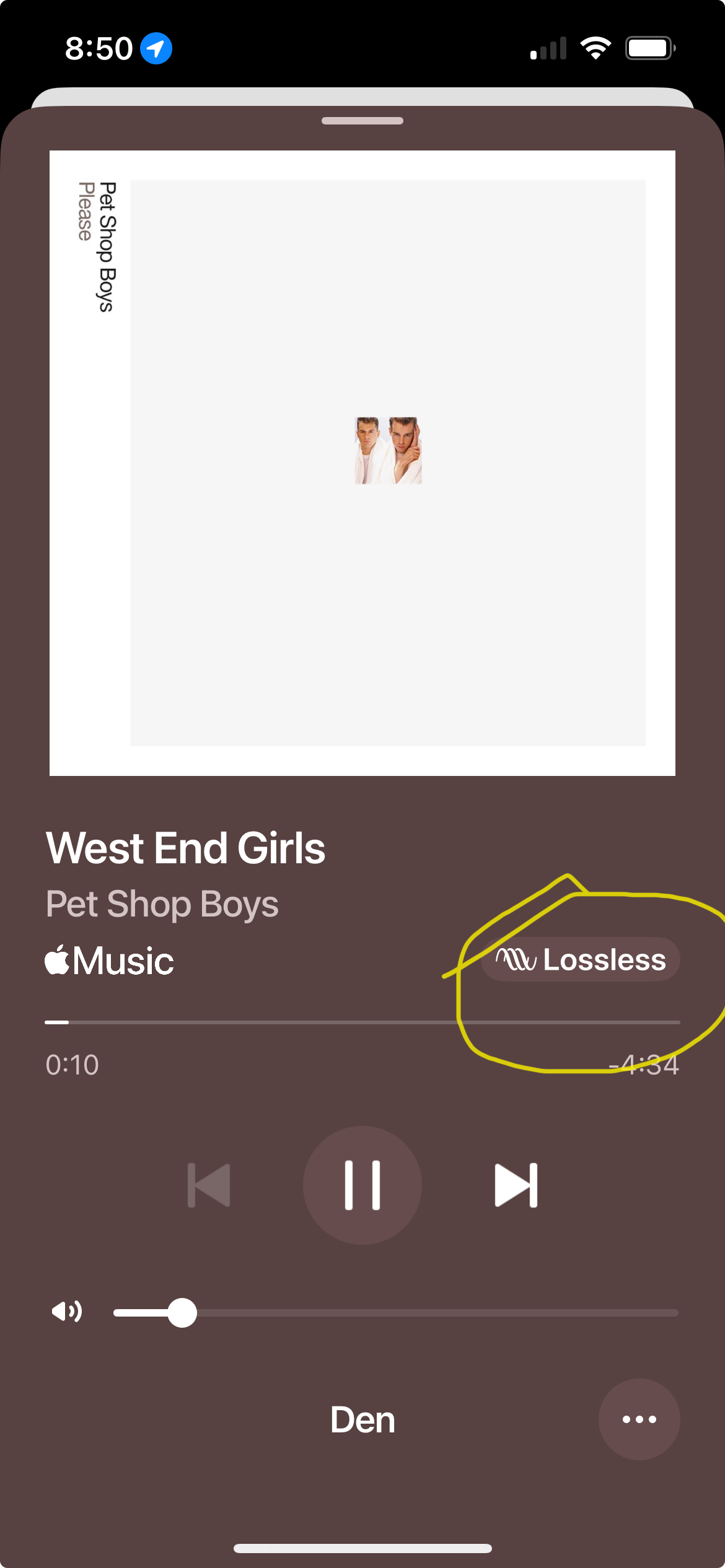
I have an Era 300 and it's logged into my Apple Music account, like before.  But now on the new app when I see what the speaker is playing it now says “Lossless”.  I don’t remember ever seeing that before.  So…. am I now getting lossless music to my Era 300?
 

This topic has been closed for further comments. You can use the search bar to find a similar topic, or create a new one by clicking Create Topic at the top of the page.
Best answer by Rhonny

Yes, Lossless from Apple Music on Sonos has been supported for about a month now. 

37 replies

RhonnyAnswer
Prodigy III
June 12, 2024

Yes, Lossless from Apple Music on Sonos has been supported for about a month now. 

Lyricist III
June 13, 2024

Do we know if this is Lossless or Hi-Res Lossless if Available. I have Tried some Tracks from The Doors that on Apple Music in Hi-Res Lossless but only Show 

Lossless in Sonos App ?

Your twisting my melon man
Lyricist III
June 13, 2024

Have tried a few tracks and on my set up Stereo pair one,one SL with Sub Mini it’s definitely better on Hi-res Losses Tracks. Anyone else had an improvement in the experience listening?

Your twisting my melon man
jgatie
June 13, 2024

Sonos can support streaming up to 24-bit, 48 kHz.  The Apple Music “Hi-Res” is probably 96 kHz or above (there is no real standard for “Hi-Res”, hence the quotes).  But don’t worry, the only thing any sample rate greater than 40 kHz does is capture the frequencies only dogs can hear, so 48 kHz is all you are ever going to need.  

Here’s some light reading on the subject from the makers of the FLAC codec (who know a thing or two about sampling audio): https://people.xiph.org/~xiphmont/demo/neil-young.html

bjuraszAuthor
Avid Contributor I
June 13, 2024

While a higher sample rate will enable the capturing of higher frequencies signals, saying that a higher sample rate does nothing to improve the sound of audible frequencies is just plain wrong.  The more you sample a signal the more accurate a representation you get of it.

Lyricist III
June 13, 2024

When I did Electronics 40 years ago Frequencies and  sample rate were completely different in my understanding the a higher sample rate will allow for more accurate separation of the frequencies we can hear. 

Your twisting my melon man
jgatie
June 13, 2024

When I did Electronics 40 years ago Frequencies and  sample rate were completely different in my understanding the a higher sample rate will allow for more accurate separation of the frequencies we can hear. 


Total myth.  The stair step representation of a sample is 100% wrong (Sony even got dinged for it, they were made to stop using it in their Hi-Res audio ads). 


Summarized from: https://en.wikipedia.org/wiki/Nyquist%E2%80%93Shannon_sampling_theorem

Intuitively we expect that when one reduces a continuous function to a discrete sequence and interpolates back to a continuous function, the fidelity of the result depends on the density (or sample rate) of the original samples. Nyquist-Shannon introduces the concept of a sample rate that is sufficient for perfect fidelity for the class of functions that are band-limited to a given bandwidth, such that no actual information is lost in the sampling process. 


A sufficient sample-rate is therefore anything larger than 2𝐵{\displaystyle 2B} samples per second. Equivalently, for a given sample rate 𝑓𝑠{\displaystyle f_{s}}, perfect reconstruction is guaranteed possible for a bandlimit 𝐵<𝑓𝑠/2{\displaystyle B<f_{s}/2}.


In other words, a sample rate of 48 kHz captures the entire signal under the 24 kHz frequency with no actual information lost.  Whatever goes in as analog from 0-24 kHz, comes out as analog from 0-24 kHz, with nothing missing.  The signal is exactly the same.   The only thing a higher sampling frequency gives you is the ability to capture higher frequencies outside the limits of human hearing.  In short, a higher sampling rate than 40 kHz being “better” is pure snake oil.  

jgatie
June 13, 2024

While a higher sample rate will enable the capturing of higher frequencies signals, saying that a higher sample rate does nothing to improve the sound of audible frequencies is just plain wrong.  The more you sample a signal the more accurate a representation you get of it.


Nope, not even close to being true.  See links above.  You can’t get any higher than perfect reproduction, and a sample rate of 2X the bandwidth desired is all it takes for perfect reproduction within the bandwidth desired.  Since anything above 20 kHz is inaudible, anything higher than 40 kHz is a waste (44.1 was chosen because it matched the rate for Sony’s Betamax tapes). 

bjuraszAuthor
Avid Contributor I
June 13, 2024

Next you’re going to tell me all DACs sound the same.  Nyquist-Shannon is correct.  But that requires circuitry that is perfect and without error.  That doesn’t exist in the real world.

jgatie
June 13, 2024

Next you’re going to tell me all DACs sound the same.  Nyquist-Shannon is correct.  But that requires circuitry that is perfect and without error.  That doesn’t exist in the real world.


Which is all covered in the link I gave above (those pesky folks at Xiph sure know what they are talking about).  It’s why they make the masters at higher sample rates, so they can force any artifacts into the inaudible realm and throw them away.  

As Monty from Xiph says above:

That's only half the story. Because digital filters have few of the practical limitations of an analog filter, we can complete the anti-aliasing process with greater efficiency and precision digitally. The very high rate raw digital signal passes through a digital anti-aliasing filter, which has no trouble fitting a transition band into a tight space. After this further digital anti-aliasing, the extra padding samples are simply thrown away. Oversampled playback approximately works in reverse.

This means we can use low rate 44.1kHz or 48kHz audio with all the fidelity benefits of 192kHz or higher sampling (smooth frequency response, low aliasing) and none of the drawbacks (ultrasonics that cause intermodulation distortion, wasted space).