
Ryan S
Retired Sonos Staff
August 29, 2018

Introducing Sonos Amp
Related content:Hardware


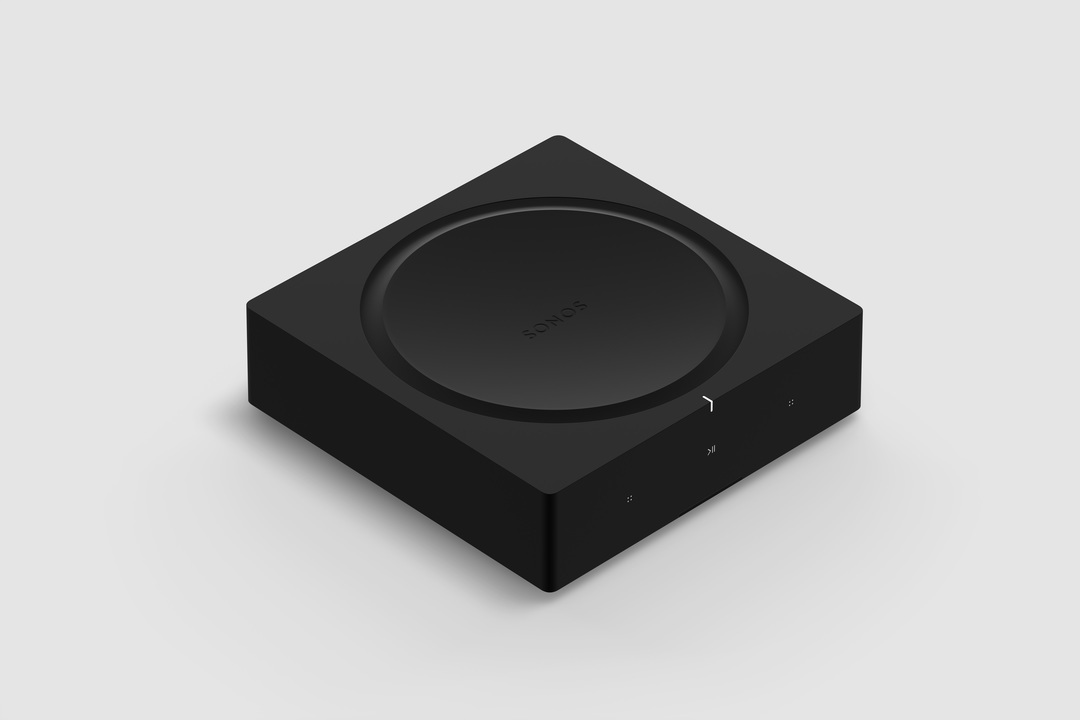
Available starting February 2019, Sonos Amp is the all-new, versatile amplifier to power all your entertainment and bring the sonic content you love to every room of your home. The Amp has been redesigned with more than twice the power of the original Connect:Amp, with more versatility, and will enable new experiences through the platform.

Play your favorite streaming content on Sonos, connect to your TV through HDMI-ARC, or plug into any audio device, including a turntable to power your vinyl collection.

Sonos Amp will fit in any home environment, whether as a compact and elegant solution for in-rack AV installations, wall mounted, tucked under furniture, or on display in a room.

Details and Specs
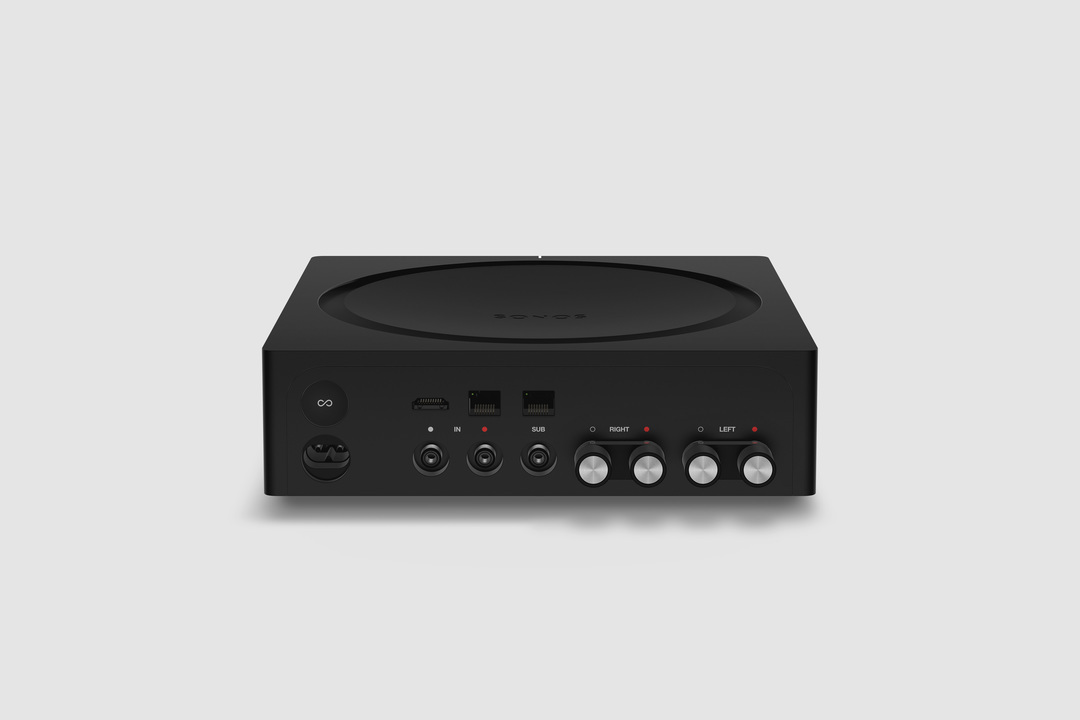


Physical Specs Amp comes in Matte black with black and silver banana plugs all in a standard rack fit size. The dimensions are 8.54 x 8.54 x 2.52 in. (217 mm (w) x 217 mm (d) x 64 mm (h)) and it weighs 4.6 lbs. (2.1 kg). Custom banana plugs that accept 10 - 18 AWG speaker wire and the Class-D digital amplifier sends a maximum of 125W per channel at 8 Ohms.

The subwoofer output is auto-detecting RCA with adjustable crossover (50 to 110Hz).

Capable of using two line-in sources, analog RCA audio input, and HDMI-ARC inputs. Amp plays Dolby Digital 5.1 or PCM stereo sound over HDMI-ARC.

Versatile Design


Use Sonos Amp to power your installed speakers as a separate Sonos room, or bond it with a pair of Sonos Ones, Play:1s, Play:3s, or Play:5s to become a surround sound setup that you can use with your TV. You can also use Amp to add your speakers as rears to a Sonos home-theater setup (by wirelessly bonding an Amp with Beam, Playbar, or Playbase) or use two Sonos Amps (one for the front right and left channels, the other for the rear channels) for surround sound.

The Sonos Amp drives left and right speakers, and it will create a phantom center channel when sent discrete audio for that channel.

Sonos Amp has all the features of Sonos in a powerful package:
  • Sonos supports over 100 services. Choose the ones you want and listen to music, podcasts, radio, and audiobooks. You can also play all the music stored on your computer or other devices.
  • Sonos has built a software platform that enables hundreds of partners and gives our customers unparalleled freedom of choice. Amp features AirPlay 2, access to home automation partners, and voice control when wirelessly connected with Amazon Echo or Alexa-enabled devices, including Sonos One and Beam.
  • Use the Sonos app on your phone or tablet, your TV remote, keypads, AirPlay 2, or your voice with Amazon Echo and Alexa-enabled devices.
  • New APIs and deeper integrations with our platform partners let you create seamless smart home control.
  • Sonos is a system. Start with Amp and expand into more rooms with additional speakers through WiFi.
  • Sonos regularly updates with new features, voice services, and API integrations, so your options are always up to date and improving.


Availability


General availability on February 5, 2019 for $599 USD (£599 GBP, €699 EUR). Early access for installed solutions professionals on December 1 in the United States and Canada. Sign up to be notified of availability on Sonos.com.

For more details, check out our blog post on the Sonos Amp here.

This topic has been closed for further comments. You can use the search bar to find a similar topic, or create a new one by clicking Create Topic at the top of the page.

364 replies

Headliner I
August 30, 2018
Currently I have a room with 2 CCM684's ceiling speakers and a Sonos Sub powered from a Sonos CA and all wired ... just for streamed music.

I want to add a new TV and Sonos Beam but currently struggling understand how to integrate all components. Not to worried about pure surround sound, just an immersive sound that the TV and can drive but also I can hit music hard to the CCM684's and Sub.

If I added Sonos Amp and pensioned off the CA, I could drive the ceiling speakers (684's), the sub and Sonos Beam with o/p from the TV? Would that be correct?

And to add a Blu-ray, I'd feed this to the TV and then HDMI ARC out to the Sonos Amp?

If you could confirm please (I'm sure the answer already above but I'm limited tech) .... if it's the case, my finger already on the 'Buy Now' button waiting for Feb 🙂
jgatie
August 30, 2018
Currently I have a room with 2 CCM684's ceiling speakers and a Sonos Sub powered from a Sonos CA and all wired ... just for streamed music.

I want to add a new TV and Sonos Beam but currently struggling understand how to integrate all components. Not to worried about pure surround sound, just an immersive sound that the TV and can drive but also I can hit music hard to the CCM684's and Sub.

If I added Sonos Amp and pensioned off the CA, I could drive the ceiling speakers (684's), the sub and Sonos Beam with o/p from the TV? Would that be correct?

And to add a Blu-ray, I'd feed this to the TV and then HDMI ARC out to the Sonos Amp?

If you could confirm please (I'm sure the answer already above but I'm limited tech) .... if it's the case, my finger already on the 'Buy Now' button waiting for Feb :-)


No need for the HDMI-ARC to the Amp. Your connections would be:

Beam connected to TV via HDMI-ARC.
Amp to ceiling speakers via speaker cable.
Sub wireless.

This will give you 5.1 sound for all TV sources. Connect all external TV sources via HDMI in on the TV, then HDMI-ARC to the Beam handles the output. Make sure you purchase a Blu-Ray that converts to DD 5.1, most Samsung models do.

When set to 'Full", it will give you multi-channel stereo from the Beam, surrounds and sub for all music sources.
melvimbe
August 30, 2018
@attacama40, you actually don't need to wait for the Sonos Amp, as the Connect:amp + Beam should be able to accomplish what you're looking for. You can setup the Beam as your front soundbar, bond your Sub to that, and then have the connect:amp drive your ceiling speakers as surround sound. That will give you a 5.1 audio when the source from the TV is in Dolby Digital 5.1. When you listen to music sources, you can set it to play full stereo, so you'd be hearing stereo from your ceiling speakers (as well as the Beam) instead of ambient sounds.

Here are the setup instrunctions for using the Connect:amp for surrounds:
https://support.sonos.com/s/article/2237?language=en_US

For your scenario what the difference between the Connect:amp and Sonos Amp will be that the Sonos amp has more power and you would no longer need to wire all the units to the network, you could use wifi.

All that said, if your existing ceiling speakers are not in a good location for surround sound, and you don't want to move them, that may not be the best route to go. Another option to just get effectively 3.1 sound (no surround) would be to connect your TV directly to a Sonos Amp, no beam involved. In that case you'd get stereo from the ceiling speakers at all times. If you wanted to get sound coming from the front as well, you could then just get a passive soundbar (should work I think), passive bookshelf or in-wall speakers also connect to the speaker ports on the Sonos Amp to play those in stereo as well. That's pretty much like what Ken was suggesting in an earlier post.

And yes, whatever source you connect to the TV (blu ray, cable, streamer, etc) will pass through the tv to play on the audio system.
Danny
sjct
Trending Lyricist I
August 30, 2018
Will the new Sonos Amp have Speech Enhancement and Night Sound modes? I like the idea of using big high end floorstanding speakers plus maybe a sub for a 2.0 or 2.1 system with TV (I don't need surround sound) to give bigger sound than a Beam or Playbar could. Also when using the Sonos Amp in a 2.0 or 2.1 set up will the phantom centre channel kick in when it receives a DD signal or do you need to have surround speakers before the phantom centre kicks in? Many thanks 🙂
NickTheGreat
Trending Lyricist I
August 30, 2018
I don't quite have an application for this product, but the more I read about it, the more interested in it I become.
Lyricist I
August 30, 2018
My main player is a Nvidia Shield TV. Using Plex, if I set the Shield to decode a codec not supported by the Sonos AMP (e.g. DTS-HD), the playback should be more or less the same as bitstreaming to a receiver that supports DTS-HD, correct? Since it is also passing through the TV via ARC, does it matter what codecs the TV supports? Thanks.
Ryan S
Ryan SAuthor
Retired Sonos Staff
August 30, 2018
Will it work with phono cables (no going silent an no lip sync problem) - my setup is very 'integrated' so getting a hdmi cable installed is not so easy... :)
The Analog RCA audio inputs are going to have the same behavior as other players with it, like the Connect:amp. They have autoplay as well, but the Analog is handled differently from the HDMI-ARC and could have a noticeable lip sync delay. Neither input should get turned off if you’re using Autoplay unless your source is very quiet for a long time, and even there, it should automatically turn back on. I’d suggest seeing if it’s at all possible to get the HDMI-ARC run so that you can get the best experience.

What about voice control?
Any plans to enable the mics in Sonos One’s when used as rears?


The mics on a pair of Sonos Ones are only disabled when bonded as surrounds with a Beam. They are fully up and running when voice is enabled and they’re being used with a Playbar, Playbase, or Sonos Amp. The Amp also has CEC over HDMI-ARC, the same as the Beam. So you’d be able to use voice control with your TV too, assuming it’s compatible.

Will the new Sonos Amp have Speech Enhancement and Night Sound modes? I like the idea of using big high end floorstanding speakers plus maybe a sub for a 2.0 or 2.1 system with TV (I don't need surround sound) to give bigger sound than a Beam or Playbar could. Also when using the Sonos Amp in a 2.0 or 2.1 set up will the phantom centre channel kick in when it receives a DD signal or do you need to have surround speakers before the phantom centre kicks in? Many thanks :)
The Speech Enhancement and Night Sound modes are functions of our TV input, and are available on all players that have it, including the new Amp. And, yes. The Amp will always try to make the fullest soundstage, with surrounds or not.

My main player is a Nvidia Shield TV. Using Plex, if I set the Shield to decode a codec not supported by the Sonos AMP (e.g. DTS-HD), the playback should be more or less the same as bitstreaming to a receiver that supports DTS-HD, correct? Since it is also passing through the TV via ARC, does it matter what codecs the TV supports? Thanks.
Over HDMI-ARC, the Amp should be asking the TV for Dolby Digital 5.1, so assuming the TV can convert the signal into that format, that’s what you’ll get. Otherwise, you may need to set Plex and or the Shield to output Dolby Digital.
Mark good posts by pressing the like button, and select the best answer on questions you've asked to help others find solutions.
Collaborator II
August 30, 2018
If I use the new Amp for the front channels could I use one of the older Amps, 100 or 120, for the back channels? Any chance of supporting a dedicated center channel with a Play1 or Play3 or Play5?
Ryan S
Ryan SAuthor
Retired Sonos Staff
August 30, 2018
If I use the new Amp for the front channels could I use one of the older Amps, 100 or 120, for the back channels?
Yes, but you'll need to wire them both into the network. The Connect:Amp doesn't have the 5GHz required for a surround sound setup.

Any chance of supporting a dedicated center channel with a Play1 or Play3 or Play5?
I can't speak to the possibility, but I'll certainly pass along your interest to the team. The phantom center channel that is created by the right and left channels is pretty impressive. But you'll have to hear it for yourself to see what you think.
Mark good posts by pressing the like button, and select the best answer on questions you've asked to help others find solutions.
melvimbe
August 30, 2018
Will it work with phono cables (no going silent an no lip sync problem) - my setup is very 'integrated' so getting a hdmi cable installed is not so easy... :)
The Analog RCA audio inputs are going to have the same behavior as other players with it, like the Connect:amp. They have autoplay as well, but the Analog is handled differently from the HDMI-ARC and could have a noticeable lip sync delay. Neither input should get turned off if you’re using Autoplay unless your source is very quiet for a long time, and even there, it should automatically turn back on. I’d suggest seeing if it’s at all possible to get the HDMI-ARC run so that you can get the best experience.


I'd also vote for allowing RCA connections to work without delay as well. My situation is slightly different though. The tv I use for outdoors doesn't stay outdoors permanently. It's actually on a rolling cart, and I rolling it outside whenever it's using. This means I'd be connecting and disconnecting the TV to the Sonos Amp all the time. With an RCA connection, I can just plug it in and go essentially. All I really want is stereo for outdoors anyway. With HDMI-ARC, I'm concerned that there will be complications with making sure the CEC handshake, etc is done properly. When the TV isn't outside, it's being used inside with the TV speakers turned on, so it's a different audio setup depending where it's used. I dunno, maybe it won't be an issue since the TV essentially goes through a cold boot whenever it's moved.

I think the point is, although a HDMI-ARC gives the best experience, there are going to be scenarios where the simpliest experience is preferred.
Danny